Aṣṭāvakra Saṃhitā
A Dialogue on Self-realization

Chapter 16, Verse 1
Order Now 
Dear child, learn or hear many scriptures in many ways. Even then you will not have Self-seatedness except by forgetting all.
Sage Ashtavakra is relentless in deriding everything and all, so that one may abide in the Self. The Self alone really is, and all else, judged in whichever manner, is appearantial, illusory and hence non-existent. Will any intelligent person run after the illusory dream object? The seeker must have the keenness, boldness, confidence and inner strength, imbued by the spirit of his enquiry, to dismiss and dispose of everything besides the Self.
Outlive, outsmart, outstrip, excel and exceed everything in thought, feeling or imagination. Nothing has any place anywhere for a devout seeker. Think of sleep. Is it not a full negation of the entire wakeful state, with all its manifold perceptions and interactions? Externally wakefulness is manifoldness. But all of it converges into one’s mind within the body. It is from the single point of the mind within your body that the whole wakefulness spreads, only to dissolve into sleep, its very source.
We are able to understand that sleep is the source of wakefulness because we repeatedly wake up from it, going back to it again and again. This is not a single or one-time experience, but repeated experience throughout our life, leaving no room for doubt. The Self you refer to as ‘I’ in the waking is revealed by the sleep state undoubtedly.
Sleep occurs only when you forget and dissolve the entire wakefulness, pointing that all-forgetfulness is the way to reach the Self.
Take the instance of meditation and its fruition. The meditator focusses his attention on a mantra. When he achieves the desired focus, to the exclusion of all distractions, he is supposed to have vṛtti-vismaraṇa, forgetting the very mental function itself. Then indeed he reaches the desired goal, the source of the very thought process.
It is exactly like wakefulness terminating in sleep. But sleep is biologically induced, not optionally generated, whereas dhyāna, maturing in samadhi, is fully optional and it transpires within wakefulness. That is how the meditator is able to understand the state he has reached and harness it when he wakes up.
This is how, as Krishna describes in Gita (2.54-72 ), the Self-absorbed sthita-prajña wakes up to become a sthita-dhee. Sthita-prajña is non-active, whereas sthita-dhee is active and interactive. As a result, he courses through duḥkha and sukha repeatedly. While doing so, neither duḥkha depresses him, nor sukha unduly delights. Likewise, the fear element also gets overwhelmed, sublimated. That is where the human mind attains transcendence. Just like a boat glides over water by the boatman swinging his oar, the sthita-dhee also glides over sukha, duḥkha and fear effortlessly. It becomes a pleasant habit of his.
That our mind can become sattva, deriving the capacity to remain afloat in all emotional urges, is the knowledge the seeker must first gain. Next, he must, by introspection and meditative absorption, acquire the ability to be a sthita-dhee. The samadhi-jñānin has to elevate himself to the vyāvahārika (interactive) jñānin, leading spiritual wisdom to its crowning glory and fulfilment.


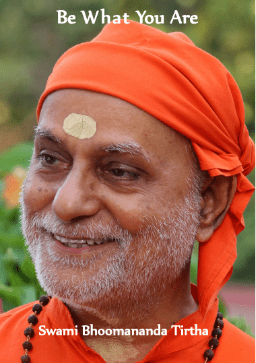



Experience a beautifully designed reading journey with authentic commentary by Poojya Swami Bhoomananda Tirtha.