


Chapter 4: Jñāna-karma-sannyāsa-yoga: – Renunciation of Actions through Enlightenment
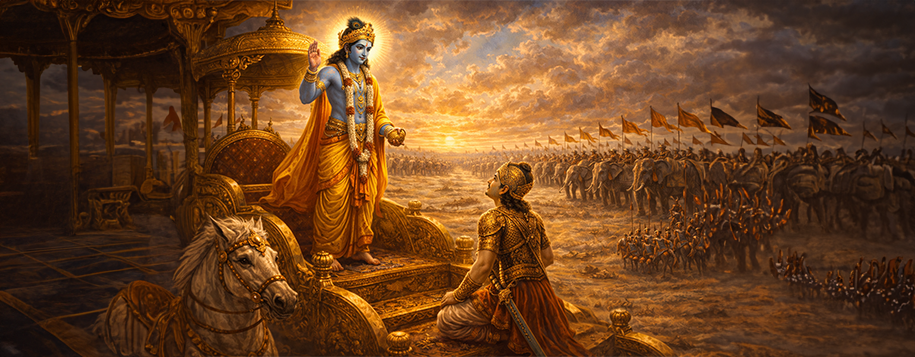
In this chapter, Sri Krishna speaks about the timeless origin of Brahmavidya (the supreme Knowledge) and the lineage of instructors (Guru-parampara), who embodied and imparted the eternal message.
Krishna then explains what action and inaction truly are. The Self is bereft of all action, no matter how active one otherwise appears to be. Equally so, even when the body is still, the mind and the other functions will be there – like digestion, circulation of blood and flow of breath which are ceaseless processes. By the knowledge and understanding of the non-acting Self, the fallacy of inaction disappears and one becomes an all-performer.
One who performs all activities being free of delusional clinging, expectations, and desires is a non-doer, even though engaged in multifarious activities. Activities do not bind a person who has renounced ego.
Activity is indispensable in Nature. However, Krishna says that in the active life, the spirit of renunciation must be ingrained. No activity, performed as a yoga, will bring any sin and bondage. Sri Krishna instructs Arjuna to get rid of all doubts by reflecting upon the Truth of the Self within and to act resolutely.
In this chapter, Sri Krishna integrates activity with spiritual knowledge. Karma, instead of posing any contradiction or hindrance, verily becomes a harmonious complement to spiritual wisdom, and spiritual wisdom, in turn, enriches Karma.
Chanting Audio
Bhagavad Gita Chapter 4
Ma Gurupriya

श्रीभगवानुवाच।
इमं विवस्वते योगं प्रोक्तवानहमव्ययम् ।
विवस्वान्मनवे प्राह मनुरिक्ष्वाकवेऽब्रवीत् ॥
English Transliteration
śrī bhagavān-uvāca
imaṃ vivasvate yogaṃ
proktavān-aham-avyayam
vivasvān-manave prāha
manur-ikṣvākave’bravīt – 4.1
Translation
Lord Krishna said: I first imparted this imperishable spiritual science (yoga) to Vivasvan. Vivasvan told Manu about it; and Manu spoke to Ikshvaku.

एवं परम्पराप्राप्तमिमं राजर्षयो विदु: ।
स कालेनेह महता योगो नष्ट: परन्तप ॥
English Transliteration
evaṃ paramparā-prāptam-
imaṃ rājarṣayo vidu:
sa kāleneha mahatā
yogo naṣṭa: parantapa – 4.2
Translation
This yoga (spiritual science), handed down thus through the Guru-śishya lineage, was possessed well by the Knower kings (Rajarshis). But by passage of inexorable time, it has got lost, O scorcher of enemies!
स एवायं मया तेऽद्य योग: प्रोक्त: पुरातन: ।
भक्तोऽसि मे सखा चेति रहस्यं ह्येतदुत्तमम् ॥
English Transliteration
sa evāyaṃ mayā te’dya
yoga: prokta: purātana:
bhakto’si me sakhā ceti
rahasyaṃ hy-etad-uttamam – 4.3
Translation
That most ancient spiritual science itself has been divulged to you by me. You are devoted to me; you are also my friend; hence, I felt like revealing to you this most beneficial secret.
अर्जुन उवाच।
अपरं भवतो जन्म परं जन्म विवस्वत: ।
कथमेतद्विजानीयां त्वमादौ प्रोक्तवानिति ॥
English Transliteration
arjuna uvāca
aparaṃ bhavato janma
paraṃ janma vivasvata:
katham-etad-vijānīyāṃ
tvam-ādau proktavān-iti – 4.4
Translation
Arjuna said: Your birth was much later, and Vivasvan’s earlier. How can I then understand that you instructed this first?
श्रीभगवानुवाच।
बहूनि मे व्यतीतानि जन्मानि तव चार्जुन ।
तान्यहं वेद सर्वाणि न त्वं वेत्थ परन्तप ॥
English Transliteration
śrī bhagavān-uvāca
bahūni me vyatītāni
janmāni tava cārjuna
tāny-ahaṃ veda sarvāṇi
na tvaṃ vettha parantapa – 4.5
Translation
Lord Krishna said: Many births have been for me, so too for you, O Arjuna. All those I know well, but, O Scorcher of foes, alas, you do not.
अजोऽपि सन्नव्ययात्मा भूतानामीश्वरोऽपि सन् ।
प्रकृतिं स्वामधिष्ठाय सम्भवाम्यात्ममायया ॥
English Transliteration
ajo’pi sann-avyayātmā
bhūtānām-īśvaro’pi san
prakṛtiṃ svām-adhiṣṭhāya
sambhavāmy-ātma-māyayā – 4.6
Translation
Although I am unborn, of indestructible nature, the Lord of all beings, by dint of my inscrutable power, wielding my own Nature, I get born again and again.
यदा यदा हि धर्मस्य ग्लानिर्भवति भारत ।
अभ्युत्थानमधर्मस्य तदात्मानं सृजाम्यहम् ॥
English Transliteration
yadā yadā hi dharmasya
glānir-bhavati bhārata
abhyutthānam-adharmasya
tadātmānaṃ sṛjāmy-aham – 4.7
परित्राणाय साधूनां विनाशाय च दुष्कृताम् ।
धर्मसंस्थापनार्थाय सम्भवामि युगे युगे ॥
English Transliteration
paritrāṇāya sādhūnāṃ
vināśāya ca duṣkṛtām
dharma-saṃsthāpanārthāya
sambhavāmi yuge yuge – 4.8
Translation
Whenever, O Bharata (Arjuna), righteousness declines and unrighteousness grows, I manifest specially. For protection of the benevolent and eradication of the wicked, to establish righteousness, I manifest time and again.
जन्म कर्म च मे दिव्यमेवं यो वेत्ति तत्त्वत: ।
त्यक्त्वा देहं पुनर्जन्म नैति मामेति सोऽर्जुन ॥
English Transliteration
janma karma ca me divyam-
evaṃ yo vetti tattvata:
tyaktvā dehaṃ punar-janma
naiti mām-eti so’rjuna – 4.9
Translation
Whoever knows in essence My birth and activity as divine in this manner, abandoning the body attains Me and does not have re-birth, O Arjuna.
वीतरागभयक्रोधा मन्मया मामुपाश्रिता: ।
बहवो ज्ञानतपसा पूता मद्भावमागता: ॥
English Transliteration
vīta-rāga-bhaya-krodhā
man-mayā mām-upāśritā:
bahavo jñāna-tapasā
pūtā mad-bhāvam-āgatā: – 4.10
Translation
Transcending passion, fear and anger, reflecting constantly upon Me, taking refuge in Me, many have become like Me getting purified by knowledge-austerity.
ये यथा मां प्रपद्यन्ते तांस्तथैव भजाम्यहम् ।
मम वर्त्मानुवर्तन्ते मनुष्या: पार्थ सर्वश: ॥
English Transliteration
ye yathā māṃ prapadyante
tāṃs-tathaiva bhajāmy-aham
mama vartmānuvartante
manuṣyā: pārtha sarvaśa: – 4.11
Translation
As men seek Me, O Partha, so do I grace them with My favour. All humans are following My path only in every way.
काङ्क्षन्त: कर्मणां सिद्धिं यजन्त इह देवता: ।
क्षिप्रं हि मानुषे लोके सिद्धिर्भवति कर्मजा ॥
English Transliteration
kāṅkṣanta: karmaṇāṃ siddhiṃ
yajanta iha devatā:
kṣipraṃ hi mānuṣe loke
siddhir-bhavati karmajā – 4.12
Translation
People worship various deities, aspiring the rewards of rituals. In the human world, fruition of such piecemeal worship is easily had.
चातुर्वर्ण्यं मया सृष्टं गुणकर्मविभागश: ।
तस्य कर्तारमपि मां विद्ध्यकर्तारमव्ययम् ॥
English Transliteration
cātur-varṇyaṃ mayā sṛṣṭaṃ
guṇa-karma-vibhāgaśa:
tasya kartāram-api māṃ
viddhy-akartāram-avyayam – 4.13
Translation
The arrangement called four-fold varṇas, based upon the inner qualities and outer activities of people, is instituted by Me. Though the Creator of such a categorization, know Me as a Non-doer, the Imperishable.
न मां कर्माणि लिम्पन्ति न मे कर्मफले स्पृहा ।
इति मां योऽभिजानाति कर्मभिर्न स बध्यते ॥
English Transliteration
na māṃ karmāṇi limpanti
na me karma-phale spṛhā
iti māṃ yo’bhijānāti
karmabhir-na sa badhyate – 4.14
Translation
Actions do not taint me. For, I have no yearning for the result of any action. Whoever understands me in this manner, will not be bound by the actions he does.
एवं ज्ञात्वा कृतं कर्म पूर्वैरपि मुमुक्षुभि: ।
कुरु कर्मैव तस्मात्त्वं पूर्वै: पूर्वतरं कृतम् ॥
English Transliteration
evaṃ jñātvā kṛtaṃ karma
pūrvair-api mumukṣubhi:
kuru karmaiva tasmāt-tvaṃ
pūrvai: pūrvataraṃ kṛtam – 4.15
Translation
Understanding matters thus in full light, seekers in the past had performed their activities well. Therefore, you too do yours, as did your predecessors.
किं कर्म किमकर्मेति कवयोऽप्यत्र मोहिता: ।
तत्ते कर्म प्रवक्ष्यामि यज्ज्ञात्वा मोक्ष्यसेऽशुभात् ॥
English Transliteration
kiṃ karma kim-akarmeti
kavayo’py-atra mohitā:
tat-te karma pravakṣyāmi
yaj-jñātvā mokṣyase’śubhāt – 4.16
कर्मणो ह्यपि बोद्धव्यं बोद्धव्यं च विकर्मण: ।
अकर्मणश्च बोद्धव्यं गहना कर्मणो गति: ॥
English Transliteration
karmaṇo hy-api boddhavyaṃ
boddhavyaṃ ca vikarmaṇa:
akarmaṇaś-ca boddhavyaṃ
gahanā karmaṇo gati: – 4.17
Translation
Even the wise ones are confused about what constitutes right action, and what does not. Therefore, I shall tell you what is verily an action, by knowing which you will be free from the inauspicious effects thereof.
The nature of true action is to be known; so too of forbidden action. One also has to know what constitutes inaction. For, the course and consequences of action are abstruse.
कर्मण्यकर्म य: पश्येदकर्मणि च कर्म य: ।
स बुद्धिमान् मनुष्येषु स युक्त: कृत्स्नकर्मकृत् ॥
English Transliteration
karmaṇy-akarma ya: paśyed-
akarmaṇi ca karma ya:
sa buddhimān manuṣyeṣu
sa yukta: kṛtsna-karma-kṛt – 4.18
Translation
Whoever sees inaction or actionless-ness in action, and activity in inaction, is verily the wise person. He indeed is spiritually integrated. He is verily the all-doer, all-performer.
यस्य सर्वे समारम्भा: कामसङ्कल्पवर्जिता: ।
ज्ञानाग्निदग्धकर्माणं तमाहु: पण्डितं बुधा: ॥
English Transliteration
yasya sarve samārambhā:
kāma-saṅkalpa-varjitā:
jñānāgni-dagdha-karmāṇaṃ
tam-āhu: paṇḍitaṃ budhā: – 4.19
Translation
Knowledgeable people call him Wise or Enlightened, whose all undertakings are freed of desire and imagination. His all actions are burnt by the fire of wisdom.
त्यक्त्वा कर्मफलासङ्गं नित्यतृप्तो निराश्रय: ।
कर्मण्यभिप्रवृत्तोऽपि नैव किञ्चित्करोति स: ॥
English Transliteration
tyaktvā karma-phalāsaṅgaṃ
nitya-tṛpto nirāśraya:
karmaṇy-abhipravṛtto’pi
naiva kiñcit-karoti sa: – 4.20
Translation
Leaving the delusional clinging to the results of karma, ever content, free of expectation, the one who engages in activities, verily does not do anything; he remains a non-doer.
निराशीर्यतचित्तात्मा त्यक्तसर्वपरिग्रह: ।
शारीरं केवलं कर्म कुर्वन्नाप्नोति किल्बिषम् ॥
English Transliteration
nirāśīr-yata-cittātmā
tyakta-sarva-parigraha:
śārīraṃ kevalaṃ karma
kurvann-āpnoti kilbiṣam – 4.21
Translation
Bereft of desires, with sufficient restraint over mind and senses, eschewing all kinds of gifts or gains, doing only bodily (physical) activities, one will not incur sin at all.
यदृच्छालाभसन्तुष्टो द्वन्द्वातीतो विमत्सर: ।
सम: सिद्धावसिद्धौ च कृत्वापि न निबध्यते ॥
English Transliteration
yadṛcchālābha-santuṣṭo
dvandvātīto vimatsara:
sama: siddhāvasiddhau ca
kṛtvāpi na nibadhyate – 4.22
Translation
Content with whatever chance brings, rising above pairs of opposites, free of jealousy, equal in success and failure, one does not get bound by whatever he does.
गतसङ्गस्य मुक्तस्य ज्ञानावस्थितचेतस: ।
यज्ञायाचरत: कर्म समग्रं प्रविलीयते ॥
English Transliteration
gata-saṅgasya muktasya
jñānāvasthita-cetasa:
yajñāyācarata: karma
samagraṃ pravilīyate – 4.23
Translation
Outliving delusional clinging, feeling liberated, mind fixed firmly on the Truth, whatever work is done with yajña attitude gets dissolved together with its result.
ब्रह्मार्पणं ब्रह्म हविर्ब्रह्माग्नौ ब्रह्मणा हुतम् ।
ब्रह्मैव तेन गन्तव्यं ब्रह्मकर्मसमाधिना ॥
English Transliteration
brahmārpaṇaṃ brahma-havir-
brahmāgnau brahmaṇā hutam
brahmaiva tena gantavyaṃ
brahma-karma-samādhinā – 4.24
Translation
The act of offering is Brahman, the cooked rice offered is Brahman, the fire altar is Brahman, and the offerer too is Brahman. Brahman alone is to be attained by the mind as all activities get merged in Brahman.
दैवमेवापरे यज्ञं योगिन: पर्युपासते ।
ब्रह्माग्नावपरे यज्ञं यज्ञेनैवोपजुह्वति ॥
English Transliteration
daivam-evāpare yajñaṃ
yogina: paryupāsate
brahmāgnāvapare yajñaṃ
yajñenaivopajuhvati – 4.25
Translation
Some Yogis make prescribed material offerings to various deities. Some others offer their yajña by yajña itself into the fire of Brahman.
श्रोत्रादीनीन्द्रियाण्यन्ये संयमाग्निषु जुह्वति ।
शब्दादीन्विषयानन्य इन्द्रियाग्निषु जुह्वति ॥
English Transliteration
śrotrādīnīndriyāṇy-anye
saṃyamāgniṣu juhvati
śabdādīn-viṣayān-anya
indriyāgniṣu juhvati – 4.26
Translation
Some offer the senses like the ear, meaning the sensory functions like hearing, seeing, smelling, etc., into the fire of their own restraint. Still others offer sound, hearing, etc. into the fire of their respective senses.
सर्वाणीन्द्रियकर्माणि प्राणकर्माणि चापरे ।
आत्मसंयमयोगाग्नौ जुह्वति ज्ञानदीपिते ॥
English Transliteration
sarvāṇīndriya-karmāṇi
prāṇa-karmāṇi cāpare
ātma-saṃyama-yogāgnau
juhvati jñāna-dīpite – 4.27
Translation
Others offer all sensory and vital activities into the fire of the yoga of inner discipline, lit by the fire of enlightenment.
द्रव्ययज्ञास्तपोयज्ञा योगयज्ञास्तथापरे ।
स्वाध्यायज्ञानयज्ञाश्च यतय: संशितव्रता: ॥
English Transliteration
dravya-yajñās-tapo-yajñā
yoga-yajñās-tathāpare
svādhyāya-jñāna-yajñāś-ca
yataya: saṃśita-vratā: – 4.28
Translation
Still others perform yajña with materials, some through austerity, some by yoga practice, as also by spiritual study and Vedic recitations observing rigid vows and restraint.
अपाने जुह्वति प्राणं प्राणेऽपानं तथापरे ।
प्राणापानगती रुद्ध्वा प्राणायामपरायणा: ॥
English Transliteration
apāne juhvati prāṇaṃ
prāṇe’pānaṃ tathāpare
prāṇāpāna-gatī ruddhvā
prāṇāyāma-parāyaṇā: – 4.29
Translation
Some offer incoming breath (prāna) to outgoing breath (apāna), and the outgoing into the incoming. Restraining the incoming and the outgoing breaths alike, they pursue breath regulation, prāṇāyāma.
अपरे नियताहारा: प्राणान्प्राणेषु जुह्वति ।
सर्वेऽप्येते यज्ञविदो यज्ञक्षपितकल्मषा: ॥
English Transliteration
apare niyatāhārā:
prāṇān-prāṇeṣu juhvati
sarve’py-ete yajña-vido
yajña-kṣapita-kalmaṣā: – 4.30
Translation
Others, disciplining their food, offer prāṇas into prāṇas (intense activities into reduced activity). All of them know the place and worth of yajña, and have their blemishes consumed by yajña.
यज्ञशिष्टामृतभुजो यान्ति ब्रह्म सनातनम् ।
नायं लोकोऽस्त्ययज्ञस्य कुतोऽन्य: कुरुसत्तम ॥
English Transliteration
yajña-śiṣṭāmṛta-bhujo
yānti brahma sanātanam
nāyaṃ loko’sty-ayajñasya
kuto’nya: kurusattama – 4.31
Translation
Those who partake of the nectarine remains of yajña, reach the eternal Brahman. O best of Kurus, for one devoid of the yajña-spirit and pursuit, benefits of this world are not there; how then of the other.
एवं बहुविधा यज्ञा वितता ब्रह्मणो मुखे ।
कर्मजान्विद्धि तान्सर्वानेवं ज्ञात्वा विमोक्ष्यसे ॥
English Transliteration
evaṃ bahu-vidhā yajñā
vitatā brahmaṇo mukhe
karmajān-viddhi tān-sarvān-
evaṃ jñātvā vimokṣyase – 4.32
Translation
Thus, manifold yajñas are prescribed in the scriptures. But, closely studied, all these are outcomes of karma alone. Knowing this truth, one attains freedom.
श्रेयान्द्रव्यमयाद्यज्ञाज्ज्ञानयज्ञ: परन्तप ।
सर्वं कर्माखिलं पार्थ ज्ञाने परिसमाप्यते ॥
English Transliteration
śreyān-dravyamayād-yajñāj-
jñāna-yajña: parantapa
sarvaṃ karmākhilaṃ pārtha
jñāne parisamāpyate – 4.33
Translation
Jñāna-yajña, the sacrifice done through wisdom, is superior to the one in which materials are offered. All activities, O Partha, have their culmination in wisdom alone.
तद्विद्धि प्रणिपातेन परिप्रश्नेन सेवया ।
उपदेक्ष्यन्ति ते ज्ञानं ज्ञानिनस्तत्त्वदर्शिन: ॥
English Transliteration
tad-viddhi praṇipātena
paripraśnena sevayā
upadekṣyanti te jñānaṃ
jñāninas-tattva-darśina: – 4.34
Translation
To gain that knowledge, go to the Knowers, who have the right vision of Truth; prostrate before them, inquire with humility, serve them fondly. They will instruct true knowledge to you.
यज्ज्ञात्वा न पुनर्मोहमेवं यास्यसि पाण्डव ।
येन भूतान्यशेषेण द्रक्ष्यस्यात्मन्यथो मयि ॥
English Transliteration
yajjñātvā na punar-moham-
evaṃ yāsyasi pāṇḍava
yena bhūtāny-aśeṣeṇa
drakṣyasy-ātmany-atho mayi – 4.35
Translation
By knowing which you will no more court any further delusion, and whereby you will see all beings in the Self and hence in Me, the Supreme.
अपि चेदसि पापेभ्य: सर्वेभ्य: पापकृत्तम: ।
सर्वं ज्ञानप्लवेनैव वृजिनं सन्तरिष्यसि ॥
English Transliteration
api ced-asi pāpebhya:
sarvebhya: pāpa-kṛttama:
sarvaṃ jñāna-plavenaiva
vṛjinaṃ santariṣyasi – 4.36
Translation
Even if you are the most sinful of all sinners, by the raft of Knowledge you will cross the entire sea of sin.
यथैधांसि समिद्धोऽग्निर्भस्मसात्कुरुतेऽर्जुन ।
ज्ञानाग्नि: सर्वकर्माणि भस्मसात्कुरुते तथा ॥
English Transliteration
yathaidhāṃsi samiddho’gnir-
bhasmasāt-kurute’rjuna
jñānāgni: sarva-karmāṇi
bhasmasāt-kurute tathā – 4.37
Translation
Just as blazing fire reduces all the firewood into ash, the fire of Knowledge burns off all karmas into mere ash.
न हि ज्ञानेन सदृशं पवित्रमिह विद्यते ।
तत्स्वयं योगसंसिद्ध: कालेनात्मनि विन्दति ॥
English Transliteration
na hi jñānena sadṛśaṃ
pavitram-iha vidyate
tat-svayaṃ yoga-saṃsiddha:
kālenātmani vindati – 4.38
Translation
There is nothing in this world so purifying as jñāna. In due course of time, one will automatically attain it in himself, by dint of the maturity and fruition of yoga pursuit.
श्रद्धावाँल्लभते ज्ञानं तत्पर: संयतेन्द्रिय: ।
ज्ञानं लब्ध्वा परां शान्तिमचिरेणाधिगच्छति ॥
English Transliteration
śraddhāvām̐̐l-labhate jñānaṃ
tat-para: saṃyatendriya:
jñānaṃ labdhvā parāṃ śāntim-
acireṇādhigacchati – 4.39
Translation
One imbued with interest in Brahman, with senses under control and assiduously attentive, begets knowledge. After gaining knowledge, he attains supreme peace before long.
अज्ञश्चाश्रद्दधानश्च संशयात्मा विनश्यति ।
नायं लोकोऽस्ति न परो न सुखं संशयात्मन: ॥
English Transliteration
ajñaścāśraddadhānaśca
saṃśayātmā vinaśyati
nāyaṃ loko’sti na paro
na sukhaṃ saṃśayātmana: – 4.40
Translation
The ignorant, inattentive and doubtful indeed perish. For the doubtful, neither this world nor the other, nor again happiness is there.
योगसंन्यस्तकर्माणं ज्ञानसंछिन्नसंशयम् ।
आत्मवन्तं न कर्माणि निबध्नन्ति धनञ्जय ॥
English Transliteration
yoga-sannyasta-karmāṇaṃ
jñāna-sañchinna-saṃśayam
ātmavantaṃ na karmāṇi
nibadhnanti dhanañjaya – 4.41
Translation
One, who has renounced all action through yoga, whose doubts are dispelled through spiritual wisdom, who is self-seated, O Dhananjaya, actions do not bind him.
तस्मादज्ञानसंभूतं हृत्स्थं ज्ञानासिनात्मन: ।
छित्त्वैनं संशयं योगमातिष्ठोत्तिष्ठ भारत ॥
English Transliteration
tasmād-ajñāna-sambhūtaṃ
hṛtsthaṃ jñānāsinātmana:
chittvainaṃ saṃśayaṃ yogam-
ātiṣṭhottiṣṭha bhārata – 4.42
Translation
Therefore, with the sword of spiritual knowledge, cut across this doubt of your heart caused by sheer ignorance, take to samatva-yoga and get up, O Bharata (Arjuna).
ओं तत्सदिति श्रीमद्भगवद्गीतासूपनिषत्सु ब्रह्मविद्यायां योगशास्त्रे श्रीकृष्णार्जुनसंवादे ज्ञानकर्मसन्न्यासयोगो नाम चतुर्थोऽध्याय:।
English Transliteration
oṃ tat-sad-iti śrīmad-bhagavad-
gītāsūpaniṣatsu
brahma-vidyāyāṃ yoga-śāstre
śrīkṛṣṇārjuna-saṃvāde
jñāna-karma-sannyāsa-yogo nāma
caturtho’dhyāya:
Translation
Om – the symbol of Brahman, tat – that singular Reality (Brahman), sat – the ever abiding presence (Brahman).
Thus ends the fourth chapter entitled Jñāna-karma-sannyāsa Yoga, during the Srikrishna-Arjuna dialogue in Śrīmad Bhagavad Gita, constituting Yoga-śāstra, which falls within Brahmavidya as presented in the Vedic Upanishads.