

Chapter 15: Puruṣottama-yoga: – The Supreme Indweller
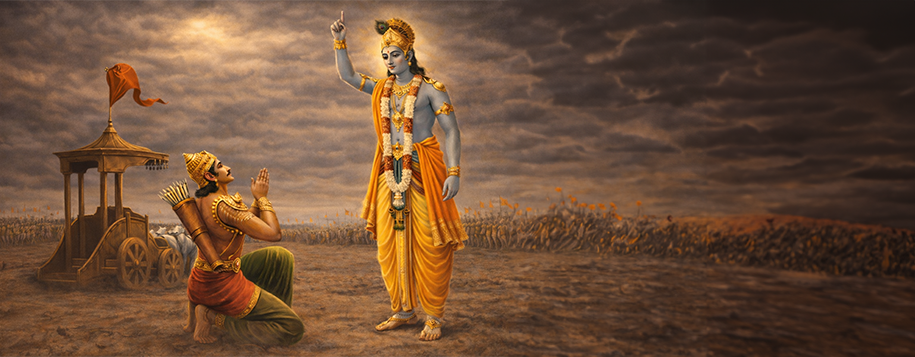
Krishna begins the chapter with an illustration of the aśvattha tree to depict the mysterious creation. As long as a person craves to enjoy the world (which is but a play of guṇas), he remains lost in the ever-changing leaves and branches of the cosmic tree. Krishna reveals how one can transcend the quagmire of this cosmic tree, the endless chain of birth and death. This firmly rooted aśvattha tree must be cut down with the sharp weapon of asaṅga (dis-attachment).
Analyzing the nature of the world, Krishna elucidates the means and disciplines by which one becomes free from all its binding effects. True spiritual pursuit purges the mind of all its dross – undue self-respect, delusional clinging, and other impurities – and eliminates the stranglehold of desires from one’s heart. To win over the world is to rise above sukha and duhkha, the dual outcome the world produces. This makes one enlightened, and enables him to reach the Imperishable abode within.
Krishna describes the inner presence that inspires and leads the intelligence, mind and senses in all their cognitive and other sensory functions. The source of all outer and inner brilliance is the Self, equally present everywhere and in everything. It is the omnipresence, which is the indweller of all. Krishna points out that the Self cannot be missed any time by an earnest enquirer.
The Paramatma, the Supreme, is the imperishable presence within. The objective of all sadhana is to get at the Self and be established there. Once this understanding becomes firm, unshakeable, that would mark the end of all doubts, agitations. Having known the ultimate Essence of all creation, the One Substratum of all existence, the seeker becomes fulfilled, for nothing further remains to be attained or gained.
Chanting Audio
Bhagavad Gita Chapter 15
Ma Gurupriya

श्रीभगवानुवाच ।
ऊर्ध्वमूलमध:शाखमश्वत्थं प्राहुरव्ययम् ।
छन्दांसि यस्य पर्णानि यस्तं वेद स वेदवित् ॥
English Transliteration
śrī bhagavān-uvāca
ūrdhvamūlam-adha:śākham-
aśvatthaṃ prāhur-avyayam
chandāṃsi yasya parṇāni
yas-taṃ veda sa veda-vit – 15.1
Translation
Lord Krishna said: The imperishable peepul tree, whose leaves are the Vedic hymns, is said to have roots upward and branches downward. Whosoever knows that, understands the import of the Vedas.

अधश्चोर्ध्वं प्रसृतास्तस्य शाखा
गुणप्रवृद्धा विषयप्रवाला: ।
अधश्च मूलान्यनुसन्ततानि
कर्मानुबन्धीनि मनुष्यलोके ॥
English Transliteration
adhaścordhvaṃ prasṛtās-tasya śākhā
guṇa-pravṛddhā viṣaya-pravālā:
adhaśca mūlāny-anusantatāni
karmānubandhīni manuṣya-loke – 15.2
Translation
Nourished by guṇas, its branches extend downwards and upwards, with their tender sprouts of sensory objects. Its roots also spread below in the human world, giving rise to bondage engendered by activities (prompted by rāga and dveṣa towards their results).
न रूपमस्येह तथोपलभ्यते
नान्तो न चादिर्न च सम्प्रतिष्ठा ।
अश्वत्थमेनं सुविरूढमूल-
मसङ्गशस्त्रेण दृढेन छित्त्वा ॥
English Transliteration
na rūpam-asyeha tathopalabhyate
nānto na cādir-na ca sampratiṣṭhā
aśvattham-enaṃ suvirūḍha-mūlam –
asaṅga-śastreṇa dṛḍhena chittvā – 15.3
तत: पदं तत्परिमार्गितव्यं
यस्मिन्गता न निवर्तन्ति भूय: ।
तमेव चाद्यं पुरुषं प्रपद्ये
यत: प्रवृत्ति: प्रसृता पुराणी ॥
English Transliteration
tata: padaṃ tat-parimārgitavyaṃ
yasmin-gatā na nivartanti bhūya:
tam-eva cādyaṃ puruṣaṃ prapadye
yata: pravṛtti: prasṛtā purāṇī – 15.4
Translation
Neither its form, beginning and end, nor details of its foundation are within our reach. Having felled this firmly rooted Aśvattha tree using the strong, sharp weapon of asaṅga (dis-attachment);
Enquire thereupon into that abode, reaching which people do not return again, the means of enquiry being: “I seek that supreme primordial Purusha, from whom has emanated this most ancient process of creation.”
निर्मानमोहा जितसङ्गदोषा
अध्यात्मनित्या विनिवृत्तकामा: ।
द्वन्द्वैर्विमुक्ता: सुखदु:खसंज्ञै-
र्गच्छन्त्यमूढा: पदमव्ययं तत् ॥
English Transliteration
nirmāna-mohā jita-saṅga-doṣā
adhyātma-nityā vinivṛtta-kāmā:
dvandvair-vimuktā: sukha-du:kha-sañjñai:
gacchanty-amūḍhā: padam-avyayaṃ tat – 15.5
Translation
Those, who are free of pride and delusion, have won over the defect of attachment, who are given to constant reflection on the supreme Reality, and are fully rid of desires; who have overcome the hold of pairs of opposites in the form of sukha and duhkha, they become free of delusion and reach that supreme imperishable Abode.
न तद्भासयते सूर्यो न शशाङ्को न पावक: ।
यद्गत्वा न निवर्तन्ते तद्धाम परमं मम ॥
English Transliteration
na tad-bhāsayate sūryo
na śaśāṅko na pāvaka:
yad-gatvā na nivartante
tad-dhāma paramaṃ mama – 15.6
Translation
That is My supreme Abode, which neither sun nor moon nor fire illumines, on reaching which there will be no return or rebirth.
ममैवांशो जीवलोके जीवभूत: सनातन: ।
मन:षष्ठानीन्द्रियाणि प्रकृतिस्थानि कर्षति ॥
English Transliteration
mamaivāṃśo jīva-loke
jīva-bhūta: sanātana:
mana:-ṣaṣṭhānīndriyāṇi
prakṛtisthāni karṣati – 15.7
शरीरं यदवाप्नोति यच्चाप्युत्क्रामतीश्वर: ।
गृहीत्वैतानि संयाति वायुर्गन्धानिवाशयात् ॥
English Transliteration
śarīraṃ yad-avāpnoti
yaccāpy-utkrāmatīśvara:
gṛhītvaitāni saṃyāti
vāyur-gandhān-ivāśayāt – 15.8
Translation
An eternal part of Me (the Supreme) becomes the jīva (individual soul, manifesting the power called life) in the world of living beings. By drawing upon the elemental nature it forms the five senses and the mind.
While taking up this body and while exiting it, the Lord (Ìśvara) brings in and takes away these sensory powers, like wind carrying fragrances from their seats (sources).
श्रोत्रं चक्षु: स्पर्शनं च रसनं घ्राणमेव च ।
अधिष्ठाय मनश्चायं विषयानुपसेवते ॥
English Transliteration
śrotraṃ cakṣu: sparśanaṃ ca
rasanaṃ ghrāṇam-eva ca
adhiṣṭhāya manaścāyaṃ
viṣayān-upasevate – 15.9
Translation
By presiding over the ear, eye, skin, tongue, nose and also the mind, it (the jīva) enjoys the (multiple qualities of) world objects.
उत्क्रामन्तं स्थितं वापि भुञ्जानं वा गुणान्वितम् ।
विमूढा नानुपश्यन्ति पश्यन्ति ज्ञानचक्षुष: ॥
English Transliteration
utkrāmantaṃ sthitaṃ vāpi
bhuñjānaṃ vā guṇānvitam
vimūḍhā nānupaśyanti
paśyanti jñāna-cakṣuṣa: – 15.10
Translation
The deluded do not perceive the Soul in Its leaving the body or residing in it, or even while experiencing sensory objects, being associated with the guṇas. Those with the eye of wisdom, however, perceive It.
यतन्तो योगिनश्चैनं पश्यन्त्यात्मन्यवस्थितम् ।
यतन्तोऽप्यकृतात्मानो नैनं पश्यन्त्यचेतस: ॥
English Transliteration
yatanto yoginaścainaṃ
paśyanty-ātmany-avasthitam
yatanto’py-akṛtātmāno
nainaṃ paśyanty-acetasa: – 15.11
Translation
Striving seekers perceive the supreme Reality as abiding in their own within. However, those who lack purity as well as discrimination fail to perceive the same, even if they strive hard.
यदादित्यगतं तेजो जगद्भासयतेऽखिलम् ।
यच्चन्द्रमसि यच्चाग्नौ तत्तेजो विद्धि मामकम् ॥
English Transliteration
yad-ādityagataṃ tejo
jagad-bhāsayate’khilam
yaccandramasi yac-cāgnau
tat-tejo viddhi māmakam – 15.12
Translation
Know the brilliance of the sun that illumines the entire world, the brilliance in the moon and also in the fire, to be from Me (the Supreme).
गामाविश्य च भूतानि धारयाम्यहमोजसा ।
पुष्णामि चौषधी: सर्वा: सोमो भूत्वा रसात्मक: ॥
English Transliteration
gām-āviśya ca bhūtāni
dhārayāmy-aham-ojasā
puṣṇāmi cauṣadhī: sarvā:
somo bhūtvā rasātmaka: – 15.13
Translation
Permeating earth, I (the Supreme) sustain beings with My splendour. Becoming lunar lustre, I nourish all herbs and vegetation with sap.
अहं वैश्वानरो भूत्वा प्राणिनां देहमाश्रित: ।
प्राणापानसमायुक्त: पचाम्यन्नं चतुर्विधम् ॥
English Transliteration
ahaṃ vaiśvānaro bhūtvā
prāṇināṃ deham-āśrita:
prāṇāpāna-samāyukta:
pacāmy-annaṃ catur-vidham – 15.14
Translation
Manifesting as fire of life (Vaiśvānara) in the bodies of creatures, I (the Supreme) conjunct with prāṇa and apāna (the vital forces) and digest the four-fold food.
सर्वस्य चाहं हृदि सन्निविष्टो
मत्त: स्मृतिर्ज्ञानमपोहनं च ।
वेदैश्च सर्वैरहमेव वेद्यो
वेदान्तकृद्वेदविदेव चाहम् ॥
English Transliteration
sarvasya cāhaṃ hṛdi sanniviṣṭo
matta: smṛtir-jñānam-apohanaṃ ca
vedaiśca sarvair-aham-eva vedyo
vedānta-kṛd-veda-vid-eva cāham – 15.15
Translation
I (as the Supreme) am embedded in the heart of all. Memory, wisdom and forgetfulness are from Me. I alone am to be known by all the Vedas. I am indeed the knower of the Vedas and the author of Vedanta.
द्वाविमौ पुरुषौ लोके क्षरश्चाक्षर एव च ।
क्षर: सर्वाणि भूतानि कूटस्थोऽक्षर उच्यते ॥
English Transliteration
dvāvimau puruṣau loke
kṣaraś-cākṣara eva ca
kṣara: sarvāṇi bhūtāni
kūṭastho’kṣara ucyate – 15.16
उत्तम: पुरुषस्त्वन्य: परमात्मेत्युदाहृत: ।
यो लोकत्रयमाविश्य बिभर्त्यव्यय ईश्वर: ॥
English Transliteration
uttama: puruṣas-tvanya:
paramātmety-udāhṛta:
yo loka-trayam-āviśya
bibharty-avyaya īśvara: – 15.17
Translation
There are in the world two Purushas – the perishable and the imperishable. All beings constitute the perishable. And the imperishable is said to be the unshakeable, unaffected.
The supreme Purusha, the Transcendental, is still different. That is called Paramātmā, the one permeating and sustaining all the three worlds, the all-controller
यस्मात्क्षरमतीतोऽहमक्षरादपि चोत्तम: ।
अतोऽस्मि लोके वेदे च प्रथित: पुरुषोत्तम: ॥
English Transliteration
yasmāt-kṣaram-atīto’ham-
akṣarād-api cottama:
ato’smi loke vede ca
prathita: puruṣottama: – 15.18
Translation
As I (the supreme Purusha) transcend the perishable existence and the imperishable (jīva), hence I am famous in the Vedas and the world as Purushottama.
यो मामेवमसम्मूढो जानाति पुरुषोत्तमम् ।
स सर्वविद्भजति मां सर्वभावेन भारत ॥
English Transliteration
yo mām-evam-asammūḍho
jānāti puruṣottamam
sa sarvavid-bhajati māṃ
sarva-bhāvena bhārata – 15.19
Translation
O Bhārata (Arjuna), overcoming delusion, whoever knows Me thus as the Purushottama, he, the knower of all, worships Me through all his thoughts, attitudes and actions.
इति गुह्यतमं शास्त्रमिदमुक्तं मयानघ ।
एतद्बुद्ध्वा बुद्धिमान्स्यात्कृतकृत्यश्च भारत ॥
English Transliteration
iti guhya-tamaṃ śāstram-
idam-uktaṃ mayānagha
etad-buddhvā buddhimān-syāt-
kṛtakṛtyaś-ca bhārata – 15.20
Translation
Thus is revealed to you by Me, this greatest secret of all śāstras, O sinless soul. Understanding this, O Bhārata, does one become wise and fulfilled.
ओं तत्सदिति श्रीमद्भगवद्गीतासूपनिषत्सु ब्रह्मविद्यायां योगशास्त्रे श्रीकृष्णार्जुनसंवादे पुरुषोत्तमयोगो नाम पञ्चदशोऽध्याय: ।
English Transliteration
oṃ tat-sad-iti śrīmad-bhagavad-
gītāsūpaniṣatsu brahma-vidyāyāṃ yoga-
śāstre śrīkṛṣṇārjuna-saṃvāde puruṣottama-
yogo nāma pañca-daśo’dhyāya:
Translation
Om – the symbol of Brahman, tat – that singular Reality (Brahman), sat – the ever abiding presence (Brahman).
Thus ends the fifteenth chapter entitled Purushottama Yoga, during the Srikrishna-Arjuna dialogue in Śrīmad Bhagavad Gita, constituting Yoga-śāstra, which falls within Brahmavidya as presented in the Vedic Upanishads.