Resources
52 | On Bhagavad Gita | Splendour of Exclusive Knowledge-abidance
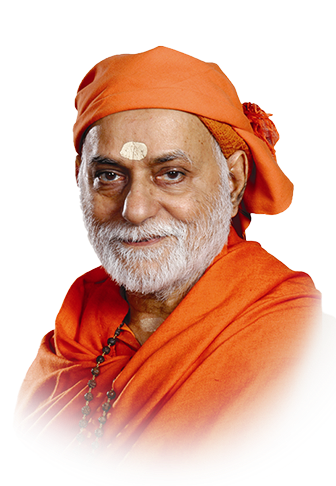
Swami Bhoomananda Tirtha
 54 views
-


 Add to Favorites
 Add to Reading List
Generate and preserve tenaciously the necessary spiritual attitude in the mind and knowledge in the intelligence. Intelligence dwells in the knowledge. Mind betakes to the attitudes cultivated on the basis of the wisdom gained. What a beautiful union, a fantastic result it fetches and bestows!
Dear and blessed souls:
Harih Om Tat Sat.
Explaining to Arjuna the intriguing proposition that nothing belongs to anyone and yet all these are available for one’s use, Krishna imparted the wonderful insight and vision on how to live in the world!
Lord does not forge any sense of doership on anyone
Next message (5.14) is of paramount importance. Krishna reveals a factor unparallelled by all means, never enumerated in any scripture of the world, and yet marks the ultimate in the human world. It is a unique aspect in the domain of knowledge accessible to our intelligence.
Krishna declares: The Lord of the universe does not enjoin on any one either any sense of doership or duties, karmas. Again, He does not impose on any one any kind of linkage with the results of whatever one does. This means that the Supreme Lord does not ask any one to engage in any set of activities, subjecting him to their consequences in the form of results. There is nothing like kartṛtva, doership or ownership, enjoined on any one in respect of any action he does. Equally so, no result is clamped on any one for whatever he has done.
Individual nature alone prevails
If this is the truth, what is then taking place in the human world every time with the immensely variant propensities and actions that people undertake from time to time? Svabhāvastu pravartate, says Krishna – every individual has his nature, inseparable from himself, expressing itself in all its variety and depth. That is all.
Every substance has its quality. Milk is white, and it has its sweetness also. It can be curdled and when churned, butter springs up. If you collect the butter and compact it into a ball, it will be floating on the curd. Is this not but the property of milk itself?
When water is cooled, it becomes ice, lighter than water and begins to float on it. Such is the property of water. On becoming ice, the volume of water increases noticeably.
In the same way, humans too have their natures. All that happens is that the nature of each gets displayed. God has nothing to do in these self-expressions. People are unable to understand this truth. Hence, they think wildly, making so many equations and get bound by them. See how boldly and freely Krishna has made such a pronouncement!
Do not, therefore, ascribe any action to any one, or attribute any result of action to any one. Let none think he acts and thereby get bound by the consequences of what he does. Considerations of any kind of ownership with regard to activities are solely due to the hold of ignorance, which does not allow true knowledge to emerge with its sovereign splendour. Ajñāna (ignorance) and jñāna (Knowledge) are the two factors that bring about all the confusion and clarity in this world.
Lord does not receive anyone’s sin or virtue
Krishna does not stop with his unique revelation. He hurriedly adds (5.15) that the Omnipresent Lord does not partake of any one’s sin or virtue at all. What transpires is that jñāna, knowledge, lies covered by ignorance in each, and under this coverage and the resulting indistinctness, people remain deluded. It is thus in sheer delusion that various kinds of attribution are made to God.
God is invisible. He is omnipresent too. Omnipresence is definitely beyond the sensory grasp of people. So, none is able to think of God in proper light. Whatever is said about and related to God, is a product of delusion. How can delusional assessments have any veracity then?
Thus, a variety of misconceptions thrive in humanity about God and what His nature is. Truth is but one. Untruths can be infinite. But this infinitude is what governs the masses. Unless the seeker sits to think dispassionately with clarity, definiteness and resoluteness, the truth will never come to light.
In every one ignorance surrounds true knowledge. As a result, he or she remains deluded. And by dint of this innate delusion, each begins to think in his or her own way, and like a worm, gets wound by the cocoon it spins around itself!
Exterminate ignorance by knowledge of the Self
Let us go to the next verse (5.16), in which Krishna elucidates what is that knowledge the seeker must attain, which removes his ignorance totally and he feels abundantly enlightened and fulfilled. That knowledge is verily of and about the Self (ātmanaḥ jñānam). Knowledge of the Self alone, when properly attained, will destroy one’s ignorance which prevents him from attaining this goal of his life.
For those in whom ignorance has thus been exterminated by knowing the Self, that knowledge will also instantly reveal the supreme Truth, assures Krishna. The outcome is not just gaining knowledge alone, but also the Ultimate Reality (param tat).
This means that Brahman is the Ultimate Truth as well as knowledge. In other words, the supreme Truth is, in fact, the supreme knowledge as well. When the Knowledge reveals the Subject Self, it shines as the supreme Truth. The enlightened knows that all the imprints of objects are subjective alone, surfacing on the Subject, thereby disproving the existence of independent objects themselves, their objectivity, in full.
This whole process transpires within the realm of knowledge. Nothing will be left to be known further. Imagine how supreme and sovereign is the knowledge process, equally so is the intelligence which engenders this knowledge, further how superlatively glorious is the Self itself, which when comprehended rightly, bestows this kind of supremacy and sovereignty!
Four-fold sadhana – the key to enlightenment
In the next verse (5.17) Krishna describes both the means of achieving this kind of fruition and the benefits it bestows. Krishna has clubbed first half of the verse into a single word, consisting of four phrases all bearing upon the content of the sadhana.
Tad-buddhayaḥ – First, one has to gain adequate spiritual wisdom, namely the knowledge of the Self dwelling in the body, the presence one denotes by the term ‘I’. ‘I’ is not just a word indicating the first personal pronoun. Instead, it is a referral point, which when probed into and comprehended well, represents the Eternal Presence in the transitory body and world alike. How great, glorious and unparallelled should such a presence be! Every bit of the body is subject to change and decay, but the ‘I’ presence is not the least affected in the process and outcome. It remains resplendent, accessible to the mind and intelligence – to the mind by the samatva attitude and to the intelligence by its subjective presence, all else being object and objective to it alone.
Tad-ātmānaḥ – this phrase conveys that the seeker should feel his identity as exclusively ‘that’, not the least the gross material mass, the body. While body is inert, the ‘I’ is not. If not inert, it must and can be only sentience, Consciousness. Yes, it is pure Consciousness, which alone has the power to reveal itself, besides revealing the rest. ‘I am’ is this self-revelation. The same ‘I’ reveals everything else also, including the body.
Tan-niṣṭhāḥ – Krishna states that the seeker should steadfastly abide in his inner identity, that he is the ‘I’, the eternal presence, nothing different, ever the least. He may pass through various emotions, thoughts, memories, reasonings and what else not. Yet he, the Self, survives all these. For, he only witnesses all the experiences as well as the things experienced, never the least becoming any of them. He witnesses ignorance, wisdom, doubt, memory, forgetfulness and the like, all equally produced by the mind, which is Consciousness’s own functional note. The eternal presence only glides through, so to say, all these, but is never involved in any of them the least.
Tat-parāyaṇāḥ – Krishna speaks about how the sadhaka takes his full refuge in the eternal presence within him alone. He has his refuge, but that refuge is the inner presence in his body.
Exclusive knowledge-abidance
Note that Krishna uses plural number, indicating that not one here or there, but many all around, take to this exclusive jñāna-niṣṭhā. And they all do attain the supreme state, wherein no further return to this world occurs (gacchanti apunarāvṛttim). How? By dint of their jñāna-niṣṭhā, as Krishna describes, all their impurities and taints get washed off by the splendour of exclusive knowledge-abidance.
Remember the chapter is named karma-sannyasa yoga. See how beautifully Krishna weaves jñānaniṣṭhā with sadhakas’ life and activities. Here what work constantly are the mind and intelligence alone. Generate and preserve tenaciously the necessary spiritual attitude in the mind and knowledge in the intelligence. Intelligence dwells in the knowledge. Mind betakes to the attitudes cultivated on the basis of the wisdom gained. What a beautiful union, a fantastic result it fetches and bestows!
“The Lord of the universe does not enjoin on any one either any sense of doership or duties, karmas. Again, He does not impose on any one any kind of linkage with the results of whatever one does.”
“Ajñāna (ignorance) and jñāna (Knowledge) are the two factors that bring about all the confusion and clarity in this world.”
“The Omnipresent Lord does not partake of any one’s sin or virtue at all.”
“Krishna speaks about how the sadhaka takes his full refuge in the eternal presence within him alone. He has his refuge, but that refuge is the inner presence in his body.”
“Every bit of the body is subject to change and decay, but the ‘I’ presence is not the least affected in the process and outcome. ”
you might be interested in


Swami Nirviseshananda Tirtha
289 – Bhakti Yoga – Bhagavad Gita Chapter 12 – 4 I Swami Nirviseshananda Tirtha
Swami Nirviseshananda Tirtha
01 – by Swami Nirviseshananda Tirtha – Three Gunas that Binds and Liberates Us
Swami Bhoomananda Tirtha
01 – ഗീതയുടെ ത്യാഗകർമോജ്വലത | ഭാഗവതത്തിലെ ഭക്തിസ്നേഹപാരമ്യത – By Swami Bhoomananda Tirtha

Swami Bhoomananda Tirtha
091 – Bhagavad Gita – Swami Bhoomananda Tirtha – Spiritual Excellence through Activity