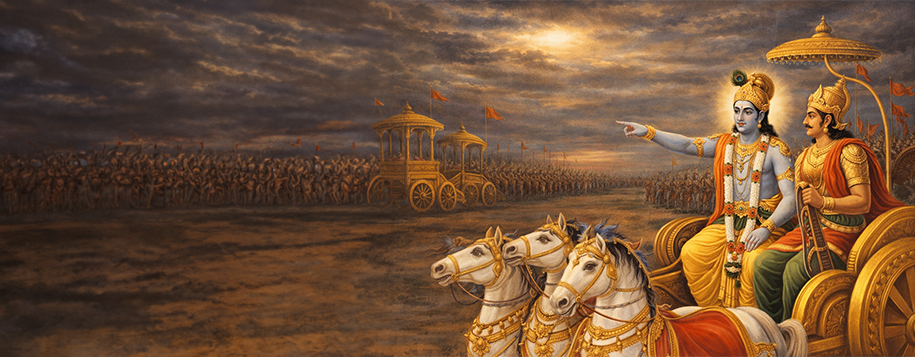


Chapter 8: Akṣara-brahma-yoga: – Comprehending the Imperishable Reality
Sri Krishna advises seekers to strive to preserve exclusiveness in their devotional practice, which is an all-fold insurance against all worldly miseries.
Krishna describes the inner supreme reality as transcending the indistinct and distinct existences. The inner source has the power to reveal the manifest as well as the un-manifest. It does so, remaining within both. The Imperishable is closer to one than even his body, mind, intelligence and ego. By Abhyasa (consistent, assiduous practice), a seeker must realize the imperishable Truth.
The real sādhana is to turn to one’s own within and reach the magnificence reigning within – which is beyond good & bad, existence & non-existence, knowledge & ignorance. Outliving concepts like birth, death, heaven and hell, etc. the seekers must regard life on earth as an occasion to elevate themselves from the clutch of the ephemeral to the embrace of the Eternal. And this must be actualised here and now.
Krishna says that without awaiting any particular period of time – auspicious or inauspicious – a seeker should try to remain connected to his true, transcendental identity, where all differences cease, and the one Imperishable alone shines brilliantly. The emphasis is not in looking into any time or situation or reward, but in realising the Truth, his own real identity.
Chanting Audio
Bhagavad Gita Chapter 8
Ma Gurupriya

अर्जुन उवाच।
किं तद्ब्रह्म किमध्यात्मं किं कर्म पुरुषोत्तम ।
अधिभूतं च किं प्रोक्तमधिदैवं किमुच्यते ॥
English Transliteration
arjuna uvāca
kiṃ tad-brahma kim-adhyātmaṃ
kiṃ karma puruṣottama
adhibhūtaṃ ca kiṃ proktam-
adhidaivaṃ kim-ucyate – 8.1
Translation
Arjuna asked: O supreme Lord, what is Brahman (supreme Reality)? What is spiritual presence? What is cosmic activity? What is said to be the material manifestation? What is described as the divine manifestation?

अधियज्ञ: कथं कोऽत्र देहेऽस्मिन्मधुसूदन ।
प्रयाणकाले च कथं ज्ञेयोऽसि नियतात्मभि: ॥
English Transliteration
adhiyajña: kathaṃ ko’tra
dehe’smin-madhusūdana
prayāṇa-kāle ca kathaṃ
jñeyo’si niyatātmabhi: – 8.2
Translation
What is the adhiyajña (Lord of sacrifices) here in this body, O slayer of Madhu (Krishna)? Even at the time of one’s death, how are You to be known by the self-disciplined seekers?
श्रीभगवानुवाच।
अक्षरं ब्रह्म परमं स्वभावोऽध्यात्ममुच्यते ।
भूतभावोद्भवकरो विसर्ग: कर्मसञ्ज्ञित: ॥
English Transliteration
śrī bhagavān-uvāca
akṣaraṃ brahma paramaṃ
svabhāvo’dhyātmam-ucyate
bhūta-bhāvodbhavakaro
visarga: karma-sañjñita: – 8.3
Translation
Lord Krishna said: The Imperishable is called the supreme Brahman. Its own sensitive, vibrant expression is adhyātma. Karma is the creative energy unleashing the elements (visargah) with their respective properties.
अधिभूतं क्षरो भाव: पुरुषश्चाधिदैवतम् ।
अधियज्ञोऽहमेवात्र देहे देहभृतां वर ॥
English Transliteration
adhibhūtaṃ kṣaro bhāva:
puruṣaścādhidaivatam
adhiyajño’ham-evātra
dehe deha-bhṛtāṃ vara – 8.4
Translation
O best among the embodied (Arjuna), adhibhūta points to the ceaseless transformation of objective existence. Adhi-daiva is the puruṣa. And adhi-yajña is the ‘I’ the resident Self in the body.
अन्तकाले च मामेव स्मरन्मुक्त्वा कलेवरम् ।
य: प्रयाति स मद्भावं याति नास्त्यत्र संशय: ॥
English Transliteration
anta-kāle ca mām-eva
smaran-muktvā kalevaram
ya: prayāti sa mad-bhāvaṃ
yāti nāsty-atra saṃśaya: – 8.5
Translation
Remembering Me alone in the end, whoever exits from the body and proceeds, attains My state. There is no doubt in this.
यं यं वापि स्मरन्भावं त्यजत्यन्ते कलेवरम् ।
तं तमेवैति कौन्तेय सदा तद्भावभावित: ॥
English Transliteration
yaṃ yaṃ vāpi smaran-bhāvaṃ
tyajaty-ante kalevaram
taṃ tam-evaiti kaunteya
sadā tad-bhāva-bhāvita: – 8.6
Translation
O Kaunteya (Arjuna), whatever one thinks or fondly contemplates upon while shedding the body, that itself he attains, governed by the law of wholesome identity.
तस्मात्सर्वेषु कालेषु मामनुस्मर युध्य च ।
मय्यर्पितमनोबुद्धिर्मामेवैष्यस्यसंशयम् ॥
English Transliteration
tasmāt-sarveṣu kāleṣu
mām-anusmara yudhya ca
mayy-arpita-mano-buddhir-
mām-evaiṣyasy-asaṃśayam – 8.7
Translation
Therefore, remember Me (the Supreme) all the time and fight. If the mind and intelligence are dedicatedly resting in Me, you will undoubtedly attain Me.
अभ्यासयोगयुक्तेन चेतसा नान्यगामिना ।
परमं पुरुषं दिव्यं याति पार्थानुचिन्तयन् ॥
English Transliteration
abhyāsa-yoga-yuktena
cetasā nānyagāminā
paramaṃ puruṣaṃ divyaṃ
yāti pārthānucintayan – 8.8
Translation
By the force of constant thinking and reflection, one attains the supreme divine Purusha, provided such thinking remains exclusive and the mind takes to it assiduously.
कविं पुराणमनुशासितारमणोरणीयांसमनुस्मरेद्य: ।
सर्वस्य धातारमचिन्त्यरूपमादित्यवर्णं तमस: परस्तात् ॥
English Transliteration
kaviṃ purāṇam-anuśāsitāram-
aṇor-aṇīyāṃsam-anusmared-ya:
sarvasya dhātāram-acintyarūpam-
ādityavarṇaṃ tamasa: parastāt – 8.9
प्रयाणकाले मनसाचलेन भक्त्या युक्तो योगबलेन चैव ।
भ्रुवोर्मध्ये प्राणमावेश्य सम्यक् स तं परं पुरुषमुपैति दिव्यम् ॥
English Transliteration
prayāṇa-kāle manasācalena
bhaktyā yukto yoga-balena caiva
bhruvor-madhye prāṇam-āveśya samyak
sa taṃ paraṃ puruṣam-upaiti divyam – 8.10
Translation
He who remembers the all-knowing, the most ancient, the governor, subtler than even the subtlest particle, sustainer of all, transcendental, luminous like the sun, but reigning beyond darkness; …
… he, even at the time of departure, with unwavering mind, imbued with devotion, integrated and strengthened by spiritual pursuit, fixing his prāṇa well between the eye-brows, attains that supreme divine Lord.
यदक्षरं वेदविदो वदन्ति विशन्ति यद्यतयो वीतरागा: ।
यदिच्छन्तो ब्रह्मचर्यं चरन्ति तत्ते पदं सङ्ग्रहेण प्रवक्ष्ये ॥
English Transliteration
yad-akṣaraṃ veda-vido vadanti
viśanti yad-yatayo vīta-rāgā:
yad-icchanto brahma-caryaṃ caranti
tat-te padaṃ saṅgraheṇa pravakṣye – 8.11
Translation
I shall briefly tell you that state which Vedic Knowers hold as Indestructible, which those transcending desires enter, and seeking which people observe life-long celibacy.
सर्वद्वाराणि संयम्य मनो हृदि निरुध्य च ।
मूर्ध्न्याधायात्मन: प्राणमास्थितो योगधारणाम् ॥
English Transliteration
sarva-dvārāṇi saṃyamya
mano hṛdi nirudhya ca
mūrdhny-ādhāyātmana: prāṇam-
āsthito yoga-dhāraṇām – 8.12
ओमित्येकाक्षरं ब्रह्म व्याहरन्मामनुस्मरन् ।
य: प्रयाति त्यजन्देहं स याति परमां गतिम् ॥
English Transliteration
om-ity-ekākṣaraṃ brahma
vyāharan-mām-anusmaran
ya: prayāti tyajan-dehaṃ
sa yāti paramāṃ gatim – 8.13
Translation
Restraining all sensory openings, fixing the mind in the heart, centering the prāṇa (vital forces) in the topmost point of the head, remaining stable in yogic concentration;…
…fervently reciting the letter OM (the monosyllable representing Brahman), remembering Me, whoever sheds his body, attains the Supreme
अनन्यचेता: सततं यो मां स्मरति नित्यश: ।
तस्याहं सुलभ: पार्थ नित्ययुक्तस्य योगिन: ॥
English Transliteration
ananya-cetā: satataṃ
yo māṃ smarati nityaśa:
tasyāhaṃ sulabha: pārtha
nitya-yuktasya yogina: – 8.14
Translation
Whoever exclusively remembers Me constantly, to that ever-united yogi, I am easily available.
मामुपेत्य पुनर्जन्म दु:खालयमशाश्वतम् ।
नाप्नुवन्ति महात्मान: संसिद्धिं परमां गता: ॥
English Transliteration
mām-upetya punar-janma
du:khālayam-aśāśvatam
nāpnuvanti mahātmāna:
saṃsiddhiṃ paramāṃ gatā: – 8.15
Translation
Attaining Me, the high-souled ones beget such spiritual perfection (siddhi) that they no more fall a victim to perishability, the pitiable fate of misery.
आब्रह्मभुवनाल्लोका: पुनरावर्तिनोऽर्जुन ।
मामुपेत्य तु कौन्तेय पुनर्जन्म न विद्यते ॥
English Transliteration
ābrahma-bhuvanāl-lokā:
punarāvartino’rjuna
mām-upetya tu kaunteya
punar-janma na vidyate – 8.16
Translation
All the worlds, O Arjuna, from Brahma-loka downwards, are terminable and repetitive. (None of them has anything final or absolute to offer.) If, on the other hand, one gets to Me, he will no more have any re-birth. (It ensures absolute redemption.)
सहस्रयुगपर्यन्तमहर्यद्ब्रह्मणो विदु: ।
रात्रिं युगसहस्रान्तां तेऽहोरात्रविदो जना: ॥
English Transliteration
sahasra-yuga-paryantam-
aharyad-brahmaṇo vidu:
rātriṃ yuga-sahasrāntāṃ
te’horātra-vido janā: – 8.17
Translation
Those people who know the Creator Brahmā’s day as extending to a thousand yugas and his night also as ending after another thousand yugas, alone know the real day and night.
अव्यक्ताद्व्यक्तय: सर्वा: प्रभवन्त्यहरागमे ।
रात्र्यागमे प्रलीयन्ते तत्रैवाव्यक्तसंज्ञके ॥
English Transliteration
avyaktād-vyaktaya: sarvā:
prabhavanty-ahar-āgame
rātry-āgame pralīyante
tatraivāvyakta-sañjñake – 8.18
Translation
As the day dawns, all beings emerge from the unmanifest. And when the night comes, they dissolve into the same unmanifest.
भूतग्राम: स एवायं भूत्वा भूत्वा प्रलीयते ।
रात्र्यागमेऽवश: पार्थ प्रभवत्यहरागमे ॥
English Transliteration
bhūta-grāma: sa evāyaṃ
bhūtvā bhūtvā pralīyate
rātry-āgame’vaśa: pārtha
prabhavaty-ahar-āgame – 8.19
Translation
This entire collection of beings, O Arjuna, is helplessly born again and again, and gets dissolved as night sets in, and then again irresistibly surges forth as the day dawns.
परस्तस्मात्तु भावोऽन्योऽव्यक्तोऽव्यक्तात्सनातन: ।
य: स सर्वेषु भूतेषु नश्यत्सु न विनश्यति ॥
English Transliteration
paras-tasmāt-tu bhāvo’nyo’
vyakto’vyaktāt-sanātana:
ya: sa sarveṣu bhūteṣu
naśyatsu na vinaśyati – 8.20
Translation
Above that unmanifest reigns the superior eternal Unmanifest, which does not vanish while all beings go on perishing.
अव्यक्तोऽक्षर इत्युक्तस्तमाहु: परमां गतिम् ।
यं प्राप्य न निवर्तन्ते तद्धाम परमं मम ॥
English Transliteration
avyakto’kṣara ityuktas-
tamāhu: paramāṃ gatim
yaṃ prāpya na nivartante
taddhāma paramaṃ mama – 8.21
Translation
That supreme, absolute abode of Mine is said to be the Unmanifest and Imperishable. That is the highest destination, reaching which the yogis do not ever return to worldliness.
पुरुष: स पर: पार्थ भक्त्या लभ्यस्त्वनन्यया ।
यस्यान्त:स्थानि भूतानि येन सर्वमिदं ततम् ॥
English Transliteration
puruṣa: sa para: pārtha
bhaktyā labhyas-tv-ananyayā
yasyānta:sthāni bhūtāni
yena sarvam-idaṃ tatam – 8.22
Translation
That supreme Purusha, within whom reside all the beings, by whom all this is pervaded, is attainable by exclusive, unflinching devotion.
यत्र काले त्वनावृत्तिमावृत्तिं चैव योगिन: ।
प्रयाता यान्ति तं कालं वक्ष्यामि भरतर्षभ ॥
English Transliteration
yatra kāle tv-anāvṛttim-
āvṛttiṃ caiva yogina:
prayātā yānti taṃ kālaṃ
vakṣyāmi bharatarṣabha – 8.23
Translation
I shall now speak, O Arjuna, about the period of time, departing in which the yogis will return to this worldliness, and also that departing wherein they will not return.
अग्निर्ज्योतिरह: शुक्ल: षण्मासा उत्तरायणम् ।
तत्र प्रयाता गच्छन्ति ब्रह्म ब्रह्मविदो जना: ॥
English Transliteration
agnir-jyotir-aha: śukla:
ṣaṇ-māsā uttarāyaṇam
tatra prayātā gacchanti
brahma brahmavido janā: – 8.24
Translation
Uttarāyaṇa, associated and identified generally with six months of the year, in fact, is like fire, brilliance, day and whiteness (bespeaking the course of wisdom and ascent). Departing in that period, the Knowers attain Brahman.
धूमो रात्रिस्तथा कृष्ण: षण्मासा दक्षिणायनम् ।
तत्र चान्द्रमसं ज्योतिर्योगी प्राप्य निवर्तते ॥
English Transliteration
dhūmo rātristathā kṛṣṇa:
ṣaṇmāsā dakṣiṇāyanam
tatra cāndramasaṃ jyotir-
yogī prāpya nivartate – 8.25
Translation
Dakṣiṇāyana, associated generally with the rest of six months of the year, implies smoke, night and black, (representing ignorance, delusion and downfall). Yogis given to this path and relying upon lunar brilliance, come back again and again.
शुक्लकृष्णे गती ह्येते जगत: शाश्वते मते ।
एकया यात्यनावृत्तिमन्ययावर्तते पुन: ॥
English Transliteration
śukla-kṛṣṇe gatī hy-ete
jagata: śāśvate mate
ekayā yāty-anāvṛttim-
anyayāvartate puna: – 8.26
Translation
These bright and dark paths of the world are regarded as eternal. One takes the seeker to the Supreme and the other brings back the votary again and again to where he started.
नैते सृती पार्थ जानन्योगी मुह्यति कश्चन ।
तस्मात्सर्वेषु कालेषु योगयुक्तो भवार्जुन ॥
English Transliteration
naite sṛtī pārtha jānan-
yogī muhyati kaścana
tasmāt-sarveṣu kāleṣu
yoga-yukto bhavārjuna – 8.27
Translation
Knowing the meaning and relevance of the two paths properly, the yogi does not get deluded. Therefore, O Arjuna, be given to yoga at all times. (That will save you from all differential notions, and bestow deliverance).
वेदेषु यज्ञेषु तप:सु चैव
दानेषु यत्पुण्यफलं प्रदिष्टम् ।
अत्येति तत्सर्वमिदं विदित्वा
योगी परं स्थानमुपैति चाद्यम् ॥
English Transliteration
vedeṣu yajñeṣu tapa:su caiva
dāneṣu yat-puṇya-phalaṃ pradiṣṭam
aty-eti tat-sarvam-idaṃ viditvā
yogī paraṃ sthānam-upaiti cādyam– 8.28
Translation
Knowing the secret about this path of inner sovereign brilliance, the yogi outlives all the holy rewards and fruitions Vedas declare in the form of yajñas, austerities and dāna, and attains the supreme primordial Abode.
ओं तत्सदिति श्रीमद्भगवद्गीतासूपनिषत्सु
ब्रह्मविद्यायां योगशास्त्रे श्रीकृष्णार्जुनसंवादे
अक्षरब्रह्मयोगो नाम अष्टमोऽध्याय:।
English Transliteration
oṃ tat-sad-iti
śrīmad-bhagavad-gītāsūpaniṣatsu
brahma-vidyāyāṃ yoga-śāstre
śrīkṛṣṇārjuna-saṃvāde
akṣara-brahma-yogo nāma
aṣṭamo’dhyāya:
Translation
Om – the symbol of Brahman, tat – that singular Reality (Brahman), sat – the ever abiding presence (Brahman).
Thus ends the eighth chapter entitled Akṣara-brahma Yoga, during the Srikrishna-Arjuna dialogue in Śrīmad Bhagavad Gita, constituting Yoga-śāstra, which falls within Brahmavidya as presented in the Vedic Upanishads.