

Chapter 4: Jñāna-karma-sannyāsa-yoga: – Renunciation of Actions through EnlightenmentVerse 24
ब्रह्मार्पणं ब्रह्म हविर्ब्रह्माग्नौ ब्रह्मणा हुतम् ।
ब्रह्मैव तेन गन्तव्यं ब्रह्मकर्मसमाधिना ॥
English Transliteration
brahmārpaṇaṃ brahma-havir-
brahmāgnau brahmaṇā hutam
brahmaiva tena gantavyaṃ
brahma-karma-samādhinā – 4.24
Translation
The act of offering is Brahman, the cooked rice offered is Brahman, the fire altar is Brahman, and the offerer too is Brahman. Brahman alone is to be attained by the mind as all activities get merged in Brahman.
Chanting Audio
Chapter 4: Jñāna-karma-sannyāsa-yoga: – Renunciation of Actions through Enlightenment - Verse 24
Ma Gurupriya

Commentary
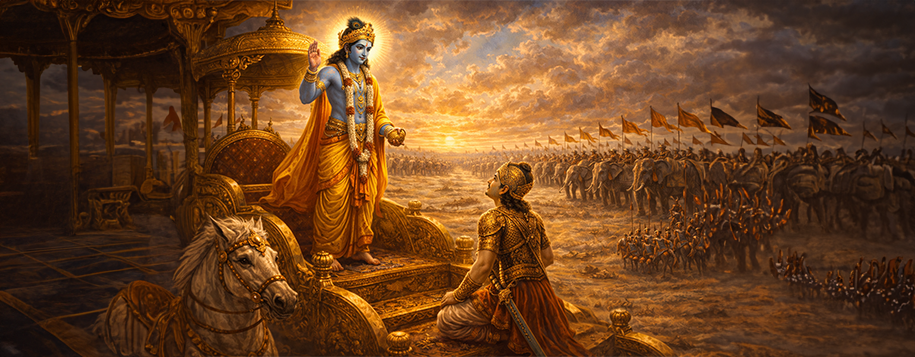
From ślokas 24 to 33, Krishna presents Yajña as an inner sacrifice, which attains its finale when all actions are done with the knowledge of Brahman – the Divine consciousness displaying all activities in Itself.
This is an exceptional pronouncement. Krishna gives his yajña thesis a ceremonial link. One who does all acts as yajña becomes a Brahma-karma-samādhin, says he. All his karmas become Brahman. Krishna illustrates this with the actual ceremonial sacrifice, with all its limbs becoming Brahman from start to finish.
Done without saṅga, all activities become equally divine. Not that the result aimed at is had after performance. The very actions themselves become Brahman. This is what Krishna had said earlier also (3.15).
The state called Brahma-karma-samādhi is like the all- flooded state Krishna cited in the 2nd chapter (2.46). There it is water everywhere, but here it is Brahman everywhere and every time, from beginning to end!
Brahman is the last word as well as attainment in spiritual life. By any means, the goal to be attained is Brahman. How does this work for one, who practises asaṅga, non- clinging, in everything he does, without going into any kind of religious or yogic overtones? Will he also have the supreme benefit?
Krishna answers this question presenting the graphics of yajña. There being nothing different from Brahman, as everything in creation is a display of Brahman itself, what is there for any special performance to gain?
Krishna explains that the ladle used in sacrifice is Brahman’s display alone. Rice offered is also Brahman. The fire in the altar into which the offering is dropped is equally Brahman. The offerer himself too is Brahman indeed. Thus the mind, intelligence, nay all, are but Brahman alone. And the outcome can also be equally Brahman.
Brahmic thought thus gives no room for any division or difference, distraction or superimposition. Krishna explains even on the ceremonial ground that Brahmic thought and contemplation are a full-fold sādhanā.
Our people have cherished this revelation with such fidelity and fervour that they have made it a practice to recite this verse at food time, especially in the Ashrams, the abodes of ascetics. Philosophy is not a theory for scholars and libraries alone. It is the cherished pursuit of seekers, no matter where they are and what they do.