

Chapter 15: Puruṣottama-yoga: – The Supreme IndwellerVerse 1
श्रीभगवानुवाच ।
ऊर्ध्वमूलमध:शाखमश्वत्थं प्राहुरव्ययम् ।
छन्दांसि यस्य पर्णानि यस्तं वेद स वेदवित् ॥
English Transliteration
śrī bhagavān-uvāca
ūrdhvamūlam-adha:śākham-
aśvatthaṃ prāhur-avyayam
chandāṃsi yasya parṇāni
yas-taṃ veda sa veda-vit – 15.1
Translation
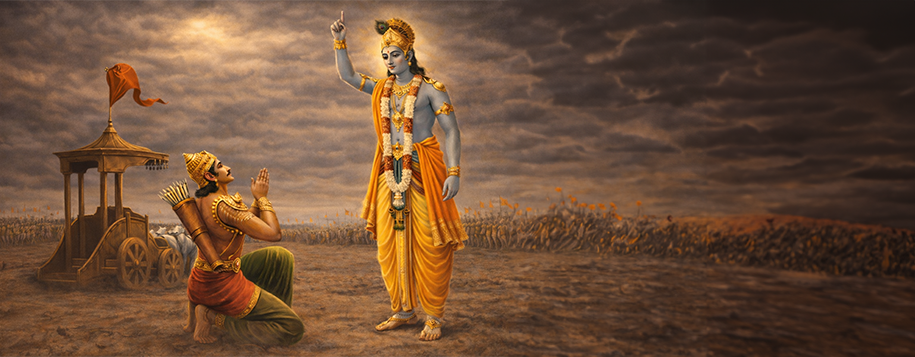
Lord Krishna said: The imperishable peepul tree, whose leaves are the Vedic hymns, is said to have roots upward and branches downward. Whosoever knows that, understands the import of the Vedas.
Chanting Audio
Chapter 15: Puruṣottama-yoga: – The Supreme Indweller - Verse 1
Swami Bhoomananda Tirtha

Commentary
Krishna is bringing a significant illustration to depict the mysterious Creation, linking Vedas as the knowledge treasure that explains the process amply. Some trees have amazing longevity, like Banyan and Peepul. But, however long its lifespan is, it is also perishable. That is why it is called “A-śva-ttha”, meaning that which will not be there tomorrow.
The Banyan tree in Kolkata Botanical gardens has already lived for over 1200 years. The tree has spread so much all around with numerous secondary roots from the branches that it is hard to find its original trunk.
Think of Creation as a time-less tree. The contrast is that it is inverted, with roots above and branches spreading below. We can deal only with its branches and leaves.
The cosmic tree will continue to grow, spreading in various directions, as modern science also finds. Universe is expanding, not circumscribed or bounded in any way.
Seeing the world-tree, man will have his own curiosity, enquiries, bearing upon the tree as well as his own life and needs, immediate as well as ultimate. It is such yearning that makes life meaningful, comfortable and fulfilling.
In answer to this, Krishna brings the immortal Vedas, which have the sole purpose of providing adequate knowledge to live in the world with wisdom, contentment and fulfilment. Vedas are a treasure-house of spiritual and subjective wisdom, different from the secular knowledge academic centres teach.
As a tree is known by studying its leaves, the secret of the world as well as the ultimate truth about Creation is known from the Vedas.
For this reason, Vedas are considered revelatory. They enlighten the human about himself, the world around, and the interactions between the two.
Vedic revelations reach their acme in the Upanishads, the last section of the four Vedas. As long as Vedas and Vedic Upanishads are there to guide us, we have full access to the very source of Creation. Upanishads exhort man to realize this inner source, be enlightened and fulfilled.