

Chapter 4: Jñāna-karma-sannyāsa-yoga: – Renunciation of Actions through EnlightenmentVerse 16-17
किं कर्म किमकर्मेति कवयोऽप्यत्र मोहिता: ।
तत्ते कर्म प्रवक्ष्यामि यज्ज्ञात्वा मोक्ष्यसेऽशुभात् ॥
English Transliteration
kiṃ karma kim-akarmeti
kavayo’py-atra mohitā:
tat-te karma pravakṣyāmi
yaj-jñātvā mokṣyase’śubhāt – 4.16
कर्मणो ह्यपि बोद्धव्यं बोद्धव्यं च विकर्मण: ।
अकर्मणश्च बोद्धव्यं गहना कर्मणो गति: ॥
English Transliteration
karmaṇo hy-api boddhavyaṃ
boddhavyaṃ ca vikarmaṇa:
akarmaṇaś-ca boddhavyaṃ
gahanā karmaṇo gati: – 4.17
Translation
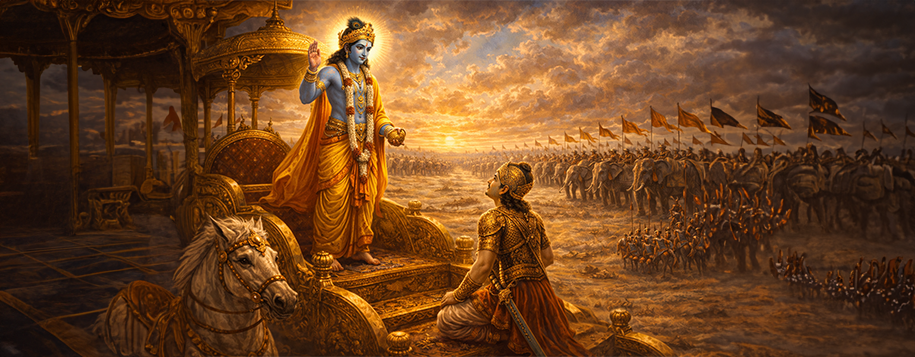
Even the wise ones are confused about what constitutes right action, and what does not. Therefore, I shall tell you what is verily an action, by knowing which you will be free from the inauspicious effects thereof.
The nature of true action is to be known; so too of forbidden action. One also has to know what constitutes inaction. For, the course and consequences of action are abstruse.
Chanting Audio
Chapter 4: Jñāna-karma-sannyāsa-yoga: – Renunciation of Actions through Enlightenment - Verse 16
Ma Gurupriya

Commentary
Krishna takes the dialogue to a very deep and philosophical level, linking it to the singular, un-involved Self he exposed in the very beginning (2.12). As he defined the concept of yajña to cover the dedicated pursuit of all actions, here too Krishna defines action and its opposite in an absolute manner, making them reflect upon the impersonal, impartial Self within.
Karma, vikarma, and akarma are three allied concepts to be understood in all their depth, relevance and import. For, karma itself, says Krishna, is an abstruse concept. The seeker has to know what is the right action allowed and upheld by the science of action. Equally so, what is forbidden action, action debarred on all grounds – derogatory and leading to downfall.
Further, what is inaction or non-action? Everyone is busy with activities, differentiating them from total non-action or idleness. None has time or wish to stop and think about what action itself means, where does it emerge from or what can we relate it to, what is its range, both while being done and by dint of its effect.
To do a task is different from trying to know about it in detail. The former is a mere physical performance, while the latter is a deep mento-intellectual pursuit, calling for ceaseless reflection and enquiry.
A sentient source alone can feel, sense, think, enquire and know. It is these inner functions that make a human distinct from the rest of beings. But our senses cannot perceive these inner, subtle functions at all, with the result they remain unexplored and unthought of by ordinary people. Krishna thus analyses the nature, depth and relevance of action.
Spirituality cannot ignore this enquiry, as this alone refines, elevates and fulfils our life. The sole object of spirituality is to enrich, empower and enlighten us.