

Chapter 3: Karma-yoga: – Transforming All Activities into YogaVerse 43
एवं बुद्धे: परं बुद्ध्वा संस्तभ्यात्मानमात्मना ।
जहि शत्रुं महाबाहो कामरूपं दुरासदम् ।।
English Transliteration
evaṃ buddhe: paraṃ buddhvā
saṃstabhyātmānam-ātmanā
jahi śatruṃ mahābāho
kāma-rūpaṃ durāsadam – 3.43
Translation
Knowing thus what reigns within the body as superior to even intelligence, confidently regulating the senses and mind by your own inner power, win over, O mighty-armed, the enemy, in the form of desire, hard to conquer.
Chanting Audio
Chapter 3: Karma-yoga: – Transforming All Activities into Yoga - Verse 43
Swami Nirviseshananda Tirtha

Commentary
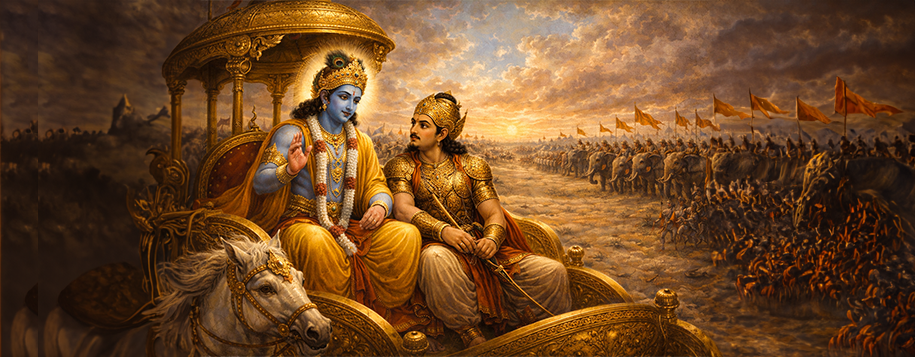
Krishna is giving the concluding call of the chapter. Have a proper understanding of your personality, the place, purpose and potential of senses, mind, intelligence and the Soul, each inward to and greater than the preceding one.
Therefore, counting upon the infinitely resourceful Soul, overcome all sense of weakness and insufficiency. The entire world is ephemeral. The Soul, the ‘I’, is everlasting. Draw abundant inspiration and strength from it, the inexhaustible.
Desire has its sway only in the senses, mind and intelligence, not beyond. Feel safe, and identify with the Soul. Win over the enemy in the form of desire. Be peaceful and contented.
The whole world is an open book of knowledge. Learn to read all its pages, reflect upon and draw timely lessons to enrich yourself, says Krishna. When he was explaining Sthita-prajña’s mastery over the senses and self-withdrawal, hence immersion in the inner freedom and fullness, he had cited the instance of the turtle (2.58). Here too he is emphasizing the importance of self-mastery, but by showing how the senses, mind and intelligence are all superior to the world objects. So, none should feel weak or diffident in the matter.
The turtle easily withdraws all its organs, whenever it feels hindered. So, the power to withdraw is inherent in our being, in the Consciousness that animates and activates the body and the senses. Like the turtle, we too must be able to safeguard ourselves from the objects of the world.
Sthita-prajña withdraws his senses, whenever he feels it necessary, and remains still and absorbed. He equally interacts as a sthita-dhee with the world, unaffectedly. Sensory regulation and inner poise go together. Each helps and complements the other, resulting in an admirable wholesome harmony!
Our life is interactional. In it our personality remains constant. Nothing in the world can independently cause an experience for us. Here comes the superiority of our senses. Mind, intelligence and the ‘I’ being still superior in sequence, live and move with an unrivalled mastery. This is the meaning and crux of spirituality!