

Chapter 3: Karma-yoga: – Transforming All Activities into YogaVerse 1-2
अर्जुन उवाच।
ज्यायसी चेत्कर्मणस्ते मता बुद्धिर्जनार्दन ।
तत्किं कर्मणि घोरे मां नियोजयसि केशव ।।
English Transliteration
arjuna uvāca
jyāyasī cet-karmaṇas-te
matā buddhir-janārdana
tat-kiṃ karmaṇi ghore māṃ
niyojayasi keśava – 3.1
व्यामिश्रेणेव वाक्येन बुद्धिं मोहयसीव मे ।
तदेकं वद निश्चित्य येन श्रेयोऽहमाप्नुयाम् ।।
English Transliteration
vyāmiśreṇeva vākyena
buddhiṃ mohayasīva me
tad-ekaṃ vada niścitya
yena śreyo’ham-āpnuyām – 3.2
Translation
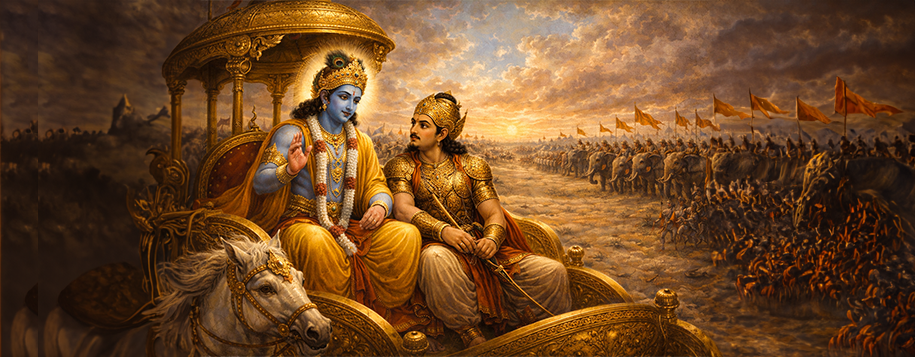
Arjuna said: If Sāṅkhya-buddhi is considered by you as superior to Karma-yoga, why do you exhort me to do this most fierce act of fighting?
You seem to be confusing my intelligence by apparently conflicting words. Tell me decisively what will bring me
everlasting good.
Chanting Audio
Chapter 3: Karma-yoga: – Transforming All Activities into Yoga - Verse 1
Swami Nirviseshananda Tirtha

Commentary
Arjuna speaks candidly. He is humble enough to say Krishna appears to confuse him by his words that seem conflicting. He does not assert or impute that it is so. What a creditable change from his earlier stand!
Krishna has already told Arjuna whatever he wanted to in the 2nd chapter. He also pictured Sthita-prajñā and Sthita-dhee, the stable-minded person, the model human. Arjuna is still not clear about the message. So he seeks clarification. This is quite natural between a student and his teacher.
Krishna exposed the truth that birth and death are solely transitional events. They do not involve or affect the Soul the least. Understanding the Soul, therefore, will alone resolve all problems of life, especially doubts and concern about the consequences of the war.
Soul-knowledge is so wholesome that it will rule out all conflicts and sufferings of life. But none can take to this lofty wisdom exclusively, and shun all activities and involvements all of a sudden.
It is necessary to remain active and involved, until one feels sufficiently dispassionate. Hence Krishna said Arjuna was ripe only to pursue karma-niṣṭhā, action-oriented sādhanā, not the exclusive contemplative life, jñāna-niṣṭhā.
This is no denial or procrastination. It is adopting the appropriate path. Arjuna somehow feels confused.
To listen to spiritual exposition is to evolve to great spiritual heights. The process cannot be sudden, but only gradual and smooth.
As he jumped earlier to withdraw from war, Arjuna now wonders if he could withdraw from active life as well!