

Chapter 1: Arjuna-viṣāda-yoga: – Transforming Grief into YogaVerse 24-25
सञ्जय उवाच ।
एवमुक्तो हृषीकेशो गुडाकेशेन भारत ।
सेनयोरुभयोर्मध्ये स्थापयित्वा रथोत्तमम् ॥
English Transliteration
sañjaya uvāca
evam-ukto hṛṣīkeśo
guḍākeśena bhārata
senayor-ubhayor-madhye
sthāpayitvā rathottamam – 1.24
भीष्मद्रोणप्रमुखत: सर्वेषां च महीक्षिताम् ।
उवाच पार्थ पश्यैतान् समवेतान् कुरूनिति ॥
English Transliteration
bhīṣma-droṇa-pramukhata:
sarveṣāṃ ca mahīkṣitām
uvāca pārtha paśyaitān
samavetān kurūn-iti – 1.25
Translation
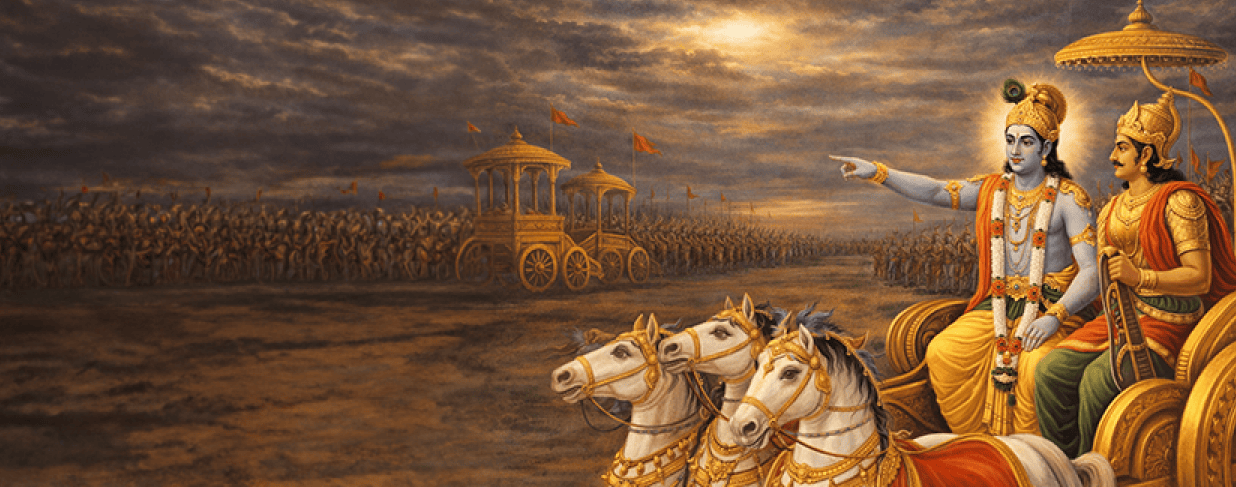
Sanjaya said: O Bhārata (Dhritarashtra, a king of the Bharata lineage)! Told like this by Arjuna (Gudakesha, the conqueror of sleep), Krishna (Hrisheekesha, the controller of senses), after stationing the chariot between the two armies, particularly in front of Bheeshma and Drona and all the other rulers, said: “Partha, see well the Kuru descendants assembled here.”
Chanting Audio
Chapter 1: Arjuna-viṣāda-yoga: – Transforming Grief into Yoga - Verse 24


Commentary
Humility is a close associate of the great. How humbly Krishna obeys the Master of his chariot!
But the greater truth should not be missed. If a devotee takes one step towards his God, God will advance Himself by two. This is what transpired in the dharmic Kurukshetra too, affirming the abstruse law of divinity.
Anything Krishna does will have its special flavour and purpose. Krishna drove on, but stationed the chariot right in front of Bheeshma, Drona and other notable leaders, and told Arjuna: “See, who all will battle against you.”
Arjuna’s intention is quite clear. But Krishna’s is subtle. He wanted Arjuna to examine himself and discern whether he was equipped to fight his grandfather, teacher and other elders.
True, throughout the long forest exile, Arjuna did severe austerities, suspending even sleep, thereby winning the name Guḍākeśa (conqueror of sleep). But would all this make one amply resourceful to face all crises, confrontations? Will material acquisitions and physical prowess alone empower one fully? Or is something more needed? If yes, how to discern and gain it?
Krishna has long been waiting for an occasion to instruct Arjuna about this powerful inner realm. Now he felt that the time was ripe for it. So, he stationed the chariot in such a place that it would reveal to Arjuna his own hollowness and compel him to seek redress.
As grandfather, Bheeshma had nursed Arjuna right from childhood. As for Dronacharya, how could Arjuna employ the archery skill against his own teacher? Both would be grave betrayal. Where lies the solution then? How to access it?