

Chapter 1: Arjuna-viṣāda-yoga: – Transforming Grief into YogaVerse 1
धृतराष्ट्र उवाच ।
धर्मक्षेत्रे कुरुक्षेत्रे समवेता युयुत्सव: ।
मामका: पाण्डवाश्चैव किमकुर्वत सञ्जय ॥
English Transliteration
dhṛtarāṣṭra uvāca
dharma-kṣetre kuru-kṣetre
samavetā yuyutsava:
māmakā: pāṇḍavāś-caiva
kim-akurvata sañjaya – 1.1
Translation
King Dhritarashtra said: O Sanjaya, having assembled in Kurukshetra, an abode of austerity and righteousness, what did my sons and those of Pandu, ambitious as they were to fight, do?
Chanting Audio
Chapter 1: Arjuna-viṣāda-yoga: – Transforming Grief into Yoga - Verse 1
Swami Nirviseshananda Tirtha

Commentary
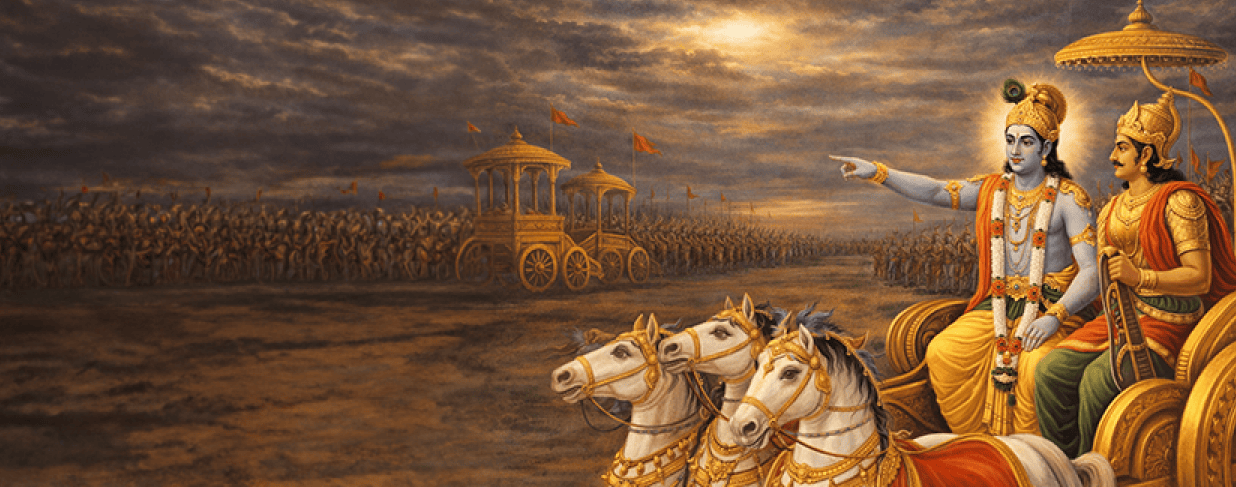
When the unprecedented Mahabharata war was in the offing, Sage Vyasa went to the Hastinapura palace and told the blind King Dhritarashtra, his son: “If you wish to see the great war, I shall gift you with a divine vision.” Dhritarashtra replied: “Which father would like to see his sons fall one after another in the war-field? So, I do not want the divine vision.”
It was then that the Sage bestowed upon Sanjaya, the King’s trusted minister, a divine power to move freely, unseen and unhurt, anywhere in the war-field and war-camps, and know first-hand all that would transpire there, so that he could report it all in detail to the King.
Sanjaya accordingly began his narration to the King describing the greatness and glory of India—its huge mountains, holy rivers, pilgrimage centres, and other legendary details.
The war suddenly began, and he rushed to Kurukshetra to witness the developments. Nine days passed. On the tenth day, the great and invincible Grandfather Bheeshma, struck by Arjuna’s arrows, fell from his chariot. Unable to bear the sight, Sanjaya ran to the King to report the event.
Hearing the news, Dhritarashtra lost all mental balance. A number of doubts, misgivings, and questions arose in his mind.
How could Arjuna, moral and ethical, do such a heinous act? Did he not have any doubt or hesitation? How did he resolve his inner conflict?
Of course, Krishna, the Master Knower, was there by his side. He was fully capable of handling any situation and guiding Arjuna.
Did any such discussion take place before the battle? If it did, Sanjaya, let me know all about it, so that my heart may find some consolation and strength to hear your further war narrations.
This is how Dhritarashtra came to ask Sanjaya about the war, as stated in the first verse of the Text.
Of the 700 verses in the Bhagavad Gita, this is the only one spoken by the blind King. The enquiry is significant and profound. It sets the tone and content of the dialogue.
Kurukshetra had the reputation of being Dharma-kshetra—the land and abode of Dharma, the science of ethics and propriety that governs human life. Dhritarashtra’s ancestor Kuru had performed prolonged austerity (tapasyā) there. Its sublime spiritual influence still enveloped and graced the place.
As the war was fought in such a holy and austere land, it could not be in violation of dharma and ethics. Surely there was something beyond the visible factors.
The blind King wished to understand the ethical relevance of Arjuna shooting down his Grandfather, who bore no enmity towards him and who, in fact, had blessed his side for victory. Arjuna himself had no ill will towards the Grandfather; he was always eager to worship him and seek his blessings.
Ultimately, whatever takes place in such an abode as Dharmakshetra Kurukshetra can only be ethical and dharmic. It is the subtle law of nature.
Much against the confidence and fervour Duryodhana was cultivating about himself and his army, the fact remained that with every step he was weakening his own position and, to that extent, strengthening that of Yudhishthira.