Resources
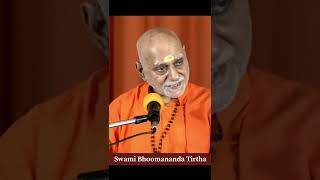
40 | On Bhagavad Gita | Non-action in Action and Action in Inaction
Swami Bhoomananda Tirtha
 910 views
-


 Add to Favorites
 Add to Reading List
A seeker should realize the truth that despite whatever the body, senses, etc. seem to do, nothing of it affects him in any manner. There is no involvement in the domain of the ‘I’. In other words, inaction is actually in understanding alone. Physically, in the gross level, no inactivity is possible. Nothing, in fact, in the world is stationary. There is vibration or movement in everything, everywhere.
Dear and blessed souls:
Harih Om Tat Sat.
Abstruse nature of action
Having explained the intricacy of discovering ‘freedom in action’ while still engaged in all-fold fierce and warlike actions, Krishna deftly presents the next verse (4.18). He says whosoever sees inaction in action, and action in inaction, is verily the wise person. He also adds that such a person alone is the most integrated (yuktaḥ). Only this kind of dexterous performer of all actions can contribute creditably to the order of world as well as mankind.
What a wholesome insight, evaluation! Krishna had said that he would explain (4.17) (i) what action is, (ii) what is forbidden action, and (iii) what is inaction, adding that the course of action is too ‘abstruse’. Thereupon what he does now is to explain action and inaction, bypassing altogether the forbidden action, he had earlier referred to!
How to understand these multi-pronged propositions? All activities in the visible domain are done by the senses and the body. In the invisible inner domain, the mind and intelligence also are active. Mind thinks, imagines, memorizes and generates emotions. Intelligence arrays reason and logic, discriminating the right from the wrong. Thus, we have the mento-intellectual involvements and their seeming outcomes. For the ordinary people, this poses intriguing complexity.
Action and inaction
With his masterly stroke, Krishna cuts across all these confusions altogether by saying the true insight is to perceive total non-action in action, and equally action in inaction. In any action, the body, senses, mind and intelligence may be involved, but not the Self, the ‘I’, which is absolutely subtle, all-pervading, and still. Self is not acting ever!
Is this not the supreme Truth he has been exposing right from the beginning of this dialogue? You are not the body. You are the ‘I’. That ‘I’ does not do any action. It seeks nothing. Why? It is Self-full, blissful and omnipresent, giving no room for anything else to be. So, it has no action and interaction at all. It is nitya (eternal), sarvagataḥ (present everywhere), sthāṇuḥ (still), achalaḥ (non-moving) (as stated in 2.12, 17, 20, 2.23-25, 2.30). This is the unshakeable position of ‘I’ in every one. Where is the question of any activity for, in or by it? All activities are seeming alone, as in dream, while the sleeper is lying still on his bed.
See that ‘I’ is not involved
Krishna now analyses akarma, inaction. By that, one can mean only non-activity of the body. He asserts that in such seeming inaction, the mind and intelligence within, in reality, certainly remain active. Mind is given to mentation and intelligence to intellection. So, there is no real inaction at all. Instead, there is full inner activity. Even breathing, heartbeat, etc. in the body are ceaselessly going on.
Being so, what should the seeker and enlightened do? He should realize the truth that despite whatever the body, senses, etc. seem to do, nothing of it affects him in any manner. There is no involvement in the domain of the ‘I’. In other words, inaction is actually in understanding alone. Physically, in the gross level, no inactivity is possible. Nothing, in fact, in the world is stationary. There is vibration or movement in everything, everywhere.
One who realizes this fact is the wise. He is the most integrated, yuktaḥ. He is the one who does all activities, without any let or hindrance. Whatever is necessary from time to time, for domestic, societal or other considerations and needs, he does freely and harmoniously. He does not need any special compulsion or persuasion to perform timely activities. His knowledge about action and inaction is so clear that he goes on acting naturally, as Nature through its guṇas, qualities, impels and persuades, himself feeling no sense of ego or possessiveness about anything at all, as Krishna himself was doing.
Now Krishna presents the first pentad (set of five) verses (4.19-23). He explains (4.19) how by the merit of true spiritual wisdom the seeker is able to burn effects of all his actions and remain free of their binding effects. This is nothing short of a wondrous exposition of human personality and the great spiritual mystery it hosts. Thus, Krishna raises the level and quality of action in general, imbuing it with the essential truth of all actions with their respective results. See what Krishna says about how should the seeker conduct his activities as a whole.
Activity is itself not deep enough to touch the very core of one’s being. Think of the various layers that constitute our personality. Are they all involved in our activity? Senses and hence the bodily level are, of course, involved. Inner mind and intelligence also are. Even the ego level is involved in its own manner. But what about the ‘I’, which is still deeper? It is the least involved in anything at all. This is the truth the seeker has to grasp and retain by repeated introspection until the realization becomes steady and one with him, and he is able to reach a state of wholesome inner, spiritual enlightenment!
Irrelevance of vikarma, forbidden action
For one who is enlightened in this manner, where is any question of vikarma, forbidden action, at all? All karmas get drowned in total inaction, no action. Where is then any scope for plural activities and differentiating them as permissible and impermissible? See how Krishna has disposed of all considerations about activities as good, bad, indifferent, etc.! What a wonderful line of thinking, taking the seeker to the true, lofty inner spiritual state of oneness and distinction-freeness!
The entire creational display is nothing but Brahman, the Supreme Reality. In other words, all are the display of Nature alone. Action or no action, all come within Nature and its qualities, guṇas, at work. None has verily any ownership over anything at all!
Resting on ‘I’
Every one passes through wakefulness, sleep and dream, the three basic states. In these, Nature and its guṇas come into display only in the wakeful state, as far as our experience and knowledge are concerned. They are totally absent in sleep and in dream they are negated as well. Where is then anything called action, for which ownership can be cast or claimed?
Every day, 16-17 hours of wakefulness, together with their actions and interactions are fully obliterated in an instant, pushing the waker into an utter nothingness and no-where-ness of sleep. To prove the unreality and illusoriness of the wakeful world, what else do we need? And this all-obliterating sleep reigns for no less than 7-8 hours a day – a fact and truth none can set aside or forget!
So do not speak of action and its various effects on the mind and intelligence. Dispose of everything and grasp the supreme unfailing and recurring presence of the ‘I’, the Self alone! Learn to rest on and reign in the ‘I’, the Self. This is the only course of true understanding the seeker has to pursue, nothing else!
Transcending the ken of virtue and vice
Think of what Krishna urged when he began the dialogue (2.50). The context was linking yoga-buddhi with all actions and interactions. Krishna clearly said that one united with yoga-buddhi (buddhi-yuktaḥ) verily abandons both sukṛta (virtue) and duṣkṛta (vice). In other words, the enrichment the seeker gains by adopting yoga-buddhi is such that he transcends the entire ken of virtue and vice. Imagine, how exalted is the state in which one abandons even virtue, finds no relevance or utility in virtue! You can eschew something desirable only when you will have something more desirable.
It is concomitant with nullifying and going beyond all karmas by seeing inaction in all of them. This is the pinnacle of Self-vision. It is interesting to note how Krishna intertwines all his statements with the same central cord of samatva-buddhi throughout the dialogue. Are not perceiving inaction in action and abandoning sukṛta (virtue) and duṣkṛta (vice) alike the same in effect?
In the light of what Krishna stated about action and inaction, and hence who is the wise person that becomes a kṛtsna-karma-kṛt, all-fold-performer, Krishna pronounces how the seeker can remain gracefully unaffected by whatever he happens to do any time anywhere for any sake at all. The seeker should reflect upon the message of each verse, assimilating and infusing it into him outright.
Fire of wisdom (jñānāgni)
Whose all undertakings are devoid of desire and allied imaginations, whose actions are fully burnt by the fire of spiritual knowledge, he indeed is an enlightened person (4.19).
Read the whole statement well. In being active, there is no adversity or bondage. But if you foster desires and desire-oriented imaginations, that is troublesome and binding. Once no desires and imaginations are there, what you do as activity gets burnt completely by the wisdom-fire. Such a person is considered as truly enlightened. See how Krishna shifts the whole emphasis from external action to internal spiritual enrichment! The message warrants the performer to be free of desire and desire-triggered crisscross imaginations.
Understand every activity as impelled by Nature’s qualities (guṇas) alone. Your body, including the brain in it, is the handiwork of Nature. What qualities prompt you to do is already impelled and shaped by Nature, the source of everything and all in creation. Blending all activities with Nature and its pulsations and motivations is what the seeker has to achieve. The whole process is an attitudinal-refinement and objectival-orientation, a work of the mind and intelligence. Krishna summarily says that action is not the focus, but mind and intelligence that shape the action. Let both act in such a manner that the seeker’s entire activity becomes an outcome of true spiritual enlightenment and Nature’s handiwork.
“You are not the body. You are the ‘I’. That ‘I’ does not do any action. It seeks nothing. Why? It is Self-full, blissful and omnipresent, giving no room for anything else to be. So, it has no action and interaction at all.”
“A wise one does not need any special compulsion or persuasion to perform timely activities. His knowledge about action and inaction is so clear that he goes on acting naturally, as Nature through its guṇas, qualities, impels and persuades, himself feeling no sense of ego or possessiveness about anything at all.”
“Activity is itself not deep enough to touch the very core of one’s being. This is the truth the seeker has to grasp and retain by repeated introspection until the realization becomes steady and one with him, and he is able to reach a state of wholesome inner, spiritual enlightenment! ”
“The entire creational display is nothing but Brahman, the Supreme Reality. In other words, all are the display of Nature alone. Action or no action, all come within Nature and its qualities, guṇas, at work. None has verily any ownership over anything at all! ”
“Every day, 16-17 hours of wakefulness, together with their actions and interactions are fully obliterated in an instant, pushing the waker into an utter nothingness and no-where-ness of sleep. To prove the unreality and illusoriness of the wakeful world, what else do we need? ”
“Dispose of everything and grasp the supreme unfailing and recurring presence of the ‘I’, the Self alone! Learn to rest on and reign in the ‘I’, the Self. This is the only course of true understanding the seeker has to pursue, nothing else! ”
“Once no desires and imaginations are there, what you do as activity gets burnt completely by the wisdom-fire. Such a person is considered as truly enlightened. ”
you might be interested in

Swami Bhoomananda Tirtha
04 – Bhagavad Gita – Swami Bhoomananda Tirtha – Meeting the Challenges of Modern Life

Ma Gurupriya
164 – Satsang With Ma I Ma Gurupriya

Swami Nirviseshananda Tirtha
243 – Taittiriya Upanishad – 29 | Voice of Upanishads | Swami Nirviseshananda Tirtha
Swami Bhoomananda Tirtha
093 – by Swami Bhoomananda Tirtha – What is Tattva?