Discourse & Satsangs
Gurupoornima Retreat 2025
START: JULY 12, 2025
03:45 PM IST
END: JULY 19, 2025
09:30 PM IST
VENUE:
Narayanashrama Tapovanam, Venginissery, P.O. Paralam, Thrissur District, Kerala - 680 563
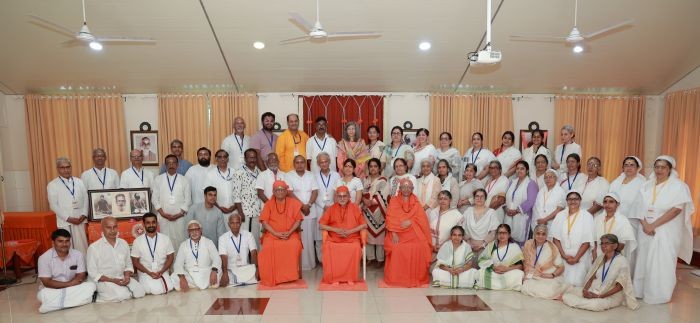
The Annual Gurupoornima Retreat was conducted from 12th July to 19th July 2025, at Narayanashrama Tapovanam, Thrissur.
(12th – 19th July)
Rekha Radhakrishnan
[The Gurupoornima Retreat was held at Narayanashrama Tapovanam from 12th to 19th July 2025, following Gurupoornima observance on the 10th. The atmosphere was filled with anticipation and excitement, with participants speculating about the theme of this year’s retreat. Many shared reflections from previous retreats and an impromptu chanting of ślokas from last year beautifully set the spiritual tone.]
Orientation Session
The Retreat commenced with an orientation session, where participants introduced themselves and shared their reasons for attending the Retreat. In an inspiring introductory talk, Poojya Swamiji spoke about the necessity to spend 50 ‘mind hours’ for gaining any quality you want to have. Maji reminded us that we should focus inward and be mindful in daily actions and interactions. Nutan Swamiji emphasized the importance of coming without any expectation, with an open and receptive mind.
Every detail of the Retreat was carefully planned to create an environment where participants could wholly immerse themselves in spiritual introspection, nurturing their mind and intelligence with clarity and depth.
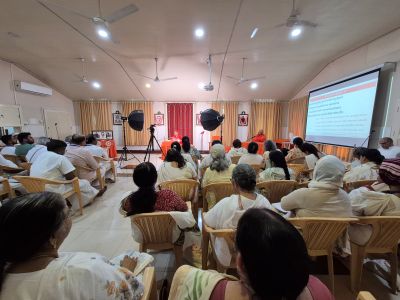 Poojya Swamiji’s energizing afternoon classes based on Viveka-cūḍāmaṇi
Viveka-cūḍāmaṇi
Poojya Swamiji’s sessions on Viveka-cūḍāmaṇi brought out the essence of the composition through carefully selected ślokas covering the breadth of the text. These were seamlessly interwoven with verses from other scriptures, adding further depth and universality to the teachings.
The sessions began with reflections on the preciousness of human birth and the immense fortune of having a Guru to guide one’s spiritual journey. Poojya Swamiji spoke about the essential qualities of a seeker and how these can be cultivated – living spiritual values in day-to-day life. He stressed the importance of approaching the Guru with humility, devotion and faith, describing the transformative power of Guru-bhakti, Guru-seva and Guru-sannidhi.
A key highlight of Swamiji’s exposition was the emphatic rejection of body-identification, supported by clear and compelling logic. With great clarity, Swamiji urged us to turn inward, encouraging each participant to transcend the body, mind and intelligence and discover the inner Presence – the spiritual core that is ever present and ready to reveal itself when the seeker is prepared to take the plunge.
Swamiji also spoke about the qualities of a Knower – a Stitha-prajña, one of steady wisdom – explaining how such a person remains calm and balanced amidst life’s fluctuations. It brought home the profound understanding that spirituality is not an escape from the world, but the art of living in the world while remaining untouched by it. For many of us householders, this message felt especially relevant and grounding.
It is said that the words of a Knower can transport a seeker into the very state the Knower lives in, provided the seeker approaches with openness, sincerity and humility. Through his illuminating words and presence, Poojya Swamiji indeed led us on the inner voyage, helping us touch that space of peace, stillness and inner joy – our Real Self.
Combined with the soulful chanting of the ślokas, the sessions had a deeply meditative and ethereal quality, leaving many participants in a state of blissful introspection. It was not just a study of scripture – it was an experience.
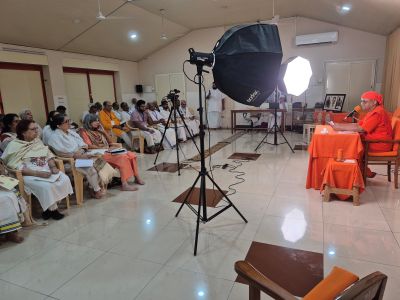 Sublime start with Nutan Swamiji’s morning discourse and Q&A on Vijñāna Nauka
Vijñāna Nauka
Nutan Swamiji, through his exposition of Vijñāna Nauka, took the participants on a journey of experiential knowledge – a voyage across the ocean of worldliness towards a destination of perpetual peace, tranquillity and happiness.
Swamiji’s light-hearted and humorous approach, combined with his hallmark clarity, scientific reasoning and logic, made the teachings not only intellectually appealing but also practical and approachable. His style helped demystify spirituality, showing how it can be seamlessly integrated into our daily lives and thoughts.
He emphasized that Viveka (discrimination) and Vairagya (dispassion) can be truly cultivated only when the mind and intelligence are purified. It is this purified mind – free of desires, attachments and aversions (rāga-dveṣa) – that becomes prepared for deep enquiry (Vichara) into our Real Identity. Swamiji’s sessions served as a compelling invitation to turn inward and awaken to that unchanging Self beyond the dualities of sukha and duḥkha.
Each session ended with the chanting of the entire Vijnana Nauka in a beautiful metre, making the learning deeply immersive and enjoyable.
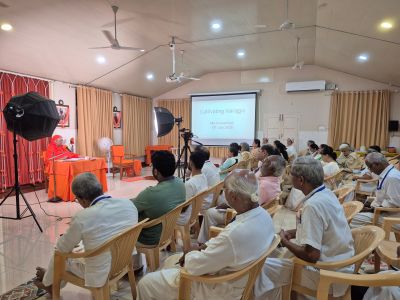 Elevating conclusion on each day with Ma Gurupriyaji’s ‘Cultivating Vairagya’
Cultivating Vairagya
Ma’s sessions focused on the cultivation of Vairagya, drawing deeply from timeless verses from Vairagya Śatakam and Viveka-cūḍāmaṇi. Her approach was both hearty and practical, as she intertwined scriptural wisdom with personal reflections from her early days of sadhana and life in the Ashram with Poojya Swamiji during the 1980s and 90s.
Through touching excerpts from her spiritual diary and simple, actionable tips, Ma made it clear that spirituality is not confined to books or discourses – it is something to be lived and practised in the fabric of our everyday lives.
She beautifully illustrated this with an analogy: Just as a river flows through twists, turns, ebbs and tides, yet remains focused on merging with the ocean, so too must our lives remain anchored in the goal of merging with the Supreme. This analogy served as a gentle reminder to live in the world but not of the world, carrying on our duties with a sense of inner detachment and surrender.
One particularly powerful moment was when Ma pointed out how each of us walks through life with a begging bowl, constantly seeking validation, acknowledgement and praise from others. This struck a deep chord – it was a stark and truthful reflection of our dependences. Ma emphasized that as bhakti (devotion to God) deepens, our dependence on the world naturally wanes and true dispassion arises from within.
She also reminded us that Viveka and Vairagya are inseparable companions on the spiritual path. One without the other is incomplete. Only together can they lead the seeker towards true inner freedom and peace.
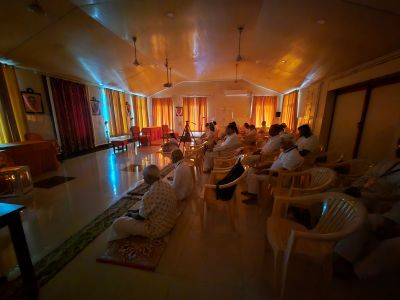 Silent Sitting in Vijnana Bhavan
Spirituality in day-to-day life
All the sessions consistently highlighted that spirituality, while rooted in deep mental and intellectual enquiry, must ultimately be lived and practised in our day-to-day life – especially through our interactions with the people around us. It is through these interactions that the true test and application of spiritual understanding take place, making the journey both meaningful and transformative.
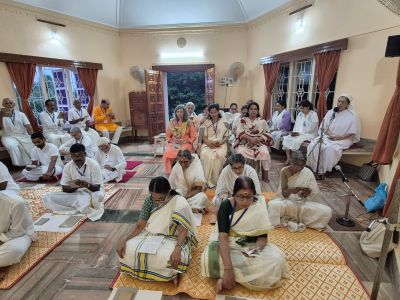 Each day of the Retreat started with sublime Morning Prayers in Samadhi Mandir
Daily activities
Each day of the Retreat began with morning prayers, followed by a session of silent sitting offering participants the opportunity to sit quietly and become aware of their thoughts, cultivating the habit of inner stillness. This quiet start set the tone for the day’s contemplative focus.
Following this was the introspection session, where participants reflected on a few practical questions, primarily drawn from the previous day’s teachings. These questions encouraged thoughtful self-inquiry, helping everyone to internalize, process and organize the knowledge in a way that could be applied meaningfully in daily life. It truly brought the learning full circle, grounding philosophical ideas in living experience.
A highlight was the group śloka chanting activity, introduced by popular demand. Participants were divided into four groups, each assigned a śloka to learn, chant, record and upload. They also selected meaningful group names and explained their choices. The activity rekindled a sense of joyful enthusiasm, with each group huddled in corners, deeply engaged in chanting and collaboration.
Behind the scene – acknowledging the Ashram team
After the Pushpa-samarpanam each day, Ma lovingly introduced the Ashram staff from various departments – Annakshetra, Accounts, Publication, Front Office, Housekeeping, Garden, etc. Each member was personally acknowledged, often with little anecdotes or touching details about his or her life and contribution. It was heartening to witness the respect and affection with which every person was recognised. This gesture reflected how deeply all the three Saints are personally interested in the well-being and growth of every member of the Ashram family.
Poojya Swamiji beautifully put it: “Just as you are householders, we are ashram-holders.” But the vision goes even further – the Ashram-family extends to the entire world, welcoming all under the vast umbrella of unconditional love, perfectly embodying the spirit of Vasudhaiva Kuṭumbakam – “The whole world is one family.”
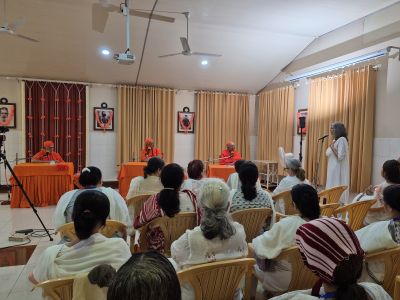 Heartfelt and inspiring sharing by participants during the concluding Feedback Session (Jul 19).
Concluding session
The retreat concluded with a feedback session where participants shared their reflections, learnings and heartfelt gratitude. This was followed by a special Jñāna Prasada from Poojya Swamiji – a set of three booklets compiled, printed and distributed during the retreat itself. These concise yet profound texts covered the three central themes of the retreat: Viveka-cūḍāmaṇi, Vijñāna Nauka and Cultivating Vairagya – serving as valuable takeaways to revisit and reflect upon.
Perhaps one of the greatest learnings was simply watching the three Masters at work. Their lives are an embodiment of the very qualities they teach – wisdom, humility, tireless dedication and unconditional love. Their presence was a silent teaching in itself, offering lessons that words cannot convey.
The Ocean of wisdom was before us – how much one could take back depended upon the size of the vessel each had.
As we return to our lives, may we carry with us this sacred experience, striving to enlarge our vessel and deepen our connection to the Self.
Jai Guru!
Drenched in Vichara, Viveka and Vairagya
By Sherry Ajemian
July rains in Kerala
It was 2:17 am in the morning of July 13 when I glanced at a notification flash on my phone that said “Thunderstorms expected” in Palakkad. The Indian Meteorological Department had issued yellow alerts for the coming days in 7 districts of Kerala of which Thrissur was one. While authorities were preparing the public to take precautionary measures for heavy rainfall, 35 devotees of Swami Bhoomananda Tirthaji were getting ready for a different type of vigilance. Their minds were about to be cascaded by Swamiji’s oceanic knowledge.
Earlier, Poojya Swamiji had expressed his wish for them to adopt the correct orientation by first recognizing they had 7 hours per day (with three masters) to embellish their inner world with insights from discourses, to bond with others through discussion exclusively on spiritual matters, and to sit still and recede into their own inner presence.
The Retreat
Introspection: Setting off to sail on the rough waters of self-inquiry, the day began with a vital aspect of spiritual sadhana – Vichara. The Vijñāna Bhavan hall opened at 8 am for silent sitting. Participants probed and cleared the mind-slate before a set of questions were tabled. The ques tions centred on what people cling to, the observation of austerities, what purification of mind entails, and prompted attendees to change the narrative of adversities as fronts of enrichment in one’s life.
Vijñāna Nauka
From Yearning to the Dawning of Wisdom. Following the introspection sessions, Swami Nirviseshanandaji introduced the Vijñāna Nauka Aṣṭakam by Adi Shankaracharya. Each verse of this poem ends with the refrain – paraṁ brahma nityaṁ tadevāham-asmi – mirroring the Mahāvākya expounded in the Bṛhadāraṇyaka Upanishad, i.e. Ahaṃ Brahmāsmi. The poem is beautifully sung in a duet by Nutan Swamiji and Ma Gurupriyaji accompanied by a rhythmic clinging of the ancient manjira. It describes the voyage of Knowledge across the sea of ignorance, and the nature of the experience of Brahman.
At the helm of the boat is the Guru, established in Brahmavidya. He is compassionate and tranquil in demeanour. Shankaracharya suggests one must be devoted to the Guru, to remain in contemplation and reflection on the truth he imparts, and to integrate what is meditated upon.
But what is this truth, this Brahman, to the common man? It cannot be conceptualized by the tools of human intellect; neither mind nor speech can express it. Instead, it is progressively revealed by peeling away one’s ignorance. Brahman is purity and freedom from bondage. It is unmatched in its wholeness and fullness emitting a splendour of light by the shining of which everything else is illumined.
It is incumbent on the voyager to turn the 2nd hand acquired knowledge (jñāna) into a 1st hand direct “knowing” or realized knowledge (vijñāna). As the seeker proceeds in sadhana, the fog clears – which Nutan Swamiji suggests in his metaphor of removing the clouds to discern the ever-present Sun. The boat voyage itself seems to have been a mirage as the seeker finds what was and has been there – nothing other than himself. The search for moksha on the horizon of the sea ends as an abiding note of wisdom transcending all states of consciousness and duality.
One may imagine a metaphysical boat to Brahman always accepting passengers, with the caveat being nāyam ātmā balahīnena labhyaḥ as per Muṇḍaka Upanishad 3.2.4. – the voyage is not for the faint-hearted.
Crest-jewel of Discrimination – Guarding the Treasure on Board
As the day progressed and participants rounded the afternoons with tea and coffee, Poojya Swamiji prepared a dose of Adi Shankara’s last composition, Viveka-cūḍāmaṇi, for those ready to muster up some gallantry of their own. Over a span of 8 lectures he covered 45 ślokas from segments of the voluminous work and covered topics ranging from the courteous exchange between the Guru and the disciple to admonitions to shun sense objects, sublimate desires and adopt a corrective stance in sadhana.
He ended his discourses with the proposition that there is no plurality at all in the vision of supreme Reality and concluded with a soft climax from Praudhānubhūti (by Adi Shankara) and a post-script śloka from the Daksiṇā-mūrti Stotras.
Viveka in the Vedantic context refers to what is Real and what is not. Like the bow of a ship breaking the water’s resistance, it is the tool to cut through ignorance. There are three thresholds to cross before the hurdle is surmounted. First comes correct evaluation of one’s life. Poojya Swamiji demanded from his listeners to recognize the three graces that had brought them to the path: human birth, desire for liberation and meeting a Mahātmā (VC śloka 3).
The second imperative would be identifying the Teacher who will steer the boat. Adi Shankara in a number of his verses points out what a realized master is, and how he moves about. He posits that a knower can only be identified after one is sufficiently enriched with Vedantic virtues. The master will not enter with any pomp into one’s life, rather he will have a blissful, serene and quiet countenance with no social compulsions or aversions or desires of his own. He will display boundless mercy and magnanimity enough to cool the burn of trepid, worn out, tormented souls that present themselves to him, just as would the moon grace the earth scorched by the sun.
The third threshold is a magnification of the focal point of the journey. It is not meditation for its own sake, nor is it samadhi for the bliss it might bring forth. It is knowledge of our own Self through “Vairagya and bodha”. However rich one’s mastery over scriptures, one needs to avail of will power and clear vision to steer far from the sharks lurking in the waters.
Shankara warns the seeker about tamo-guṇa and emphasizes cultivation of virtues as one aspect of this journey. He flags sense objects that lure the seeker and points out that the locus of avidyā is the mental sheath itself. How then will we come to know anything of this ātmā if the mind is susceptible to error?
The ātmā of its own accord will reveal itself as witness-consciousness. In a state, which is the domain of noble souls, known as nirvikalpa-samadhi, the light of truth of the eternal soul emerges. It is self-evident and self-luminous pervading all there is and is not. If samadhi is too far off, at the very least, one can chant the ślokas of Viveka-cūḍāmaṇi until they are integrated into the mind and they prepare it for this eventuality, although at the last juncture, the mind and even the rājasika-buddhi must also recede for the Self to unfold.
Yet, during the voyage, it is indeed necessary to avail of one’s buddhi and build the capacity to progressively sublimate all thoughts, impressions, vāsanas in order to ultimately affirm the sovereignty of the Self. The Self cannot co-exist with any other phenomenon. It is. And ONLY IT exists. So much so that it engulfs all else that appears on the horizon of consciousness as superimpositions it itself produces.
In fact, that Self as Brahman leaves nothing undone. The seeker then has nothing to accomplish. Driving this point home, Verse 574 hints that the starting point and ending point might be the same.
na nirodho na cotpattir-na baddho na ca sādhakaḥ .
na mumukṣur-na vai mukta ityeṣā paramārthatā .. –
Viveka-cūḍāmaṇi 574
To the chagrin of those not gifted with unalloyed intelligence to fathom Brahman, the Kena Upanishad Mantra 2.4 states:
pratibodha viditaṃ matam-amṛtatvaṃ hi vindate .
ātmanā vindate vīryaṃ vidyayā vindate‘mṛtam ..
In this mantra lies the secret code. Every moment of cognition is pregnant with the potential of intuition and revelation of this eternality, expansiveness, fullness and splendour. The seeker then with Self-knowledge gains not only a peaceful existence but immortality.
The Safe Shores with Ma
The day closed with evening sessions by Ma Gurupriyaji with a text by Sage Bhartrihari titled Vairagya Śatakam. Forlorn by the infidelity of his spouse, King Bhartrihari left his kingdom of Ujjain and became an ascetic and philosopher poet.
In discussing his work, Ma Gurupriyaji intermixed her discourses with stanzas from Viveka-cūḍāmaṇi, Sarva-vedānta-siddhānta-sāra-saṅgraha, the Bhagavad Gita and Aṣṭāvakra Saṃhitā. Reminiscing about past, she shared one of the first ślokas Swamiji taught her enjoining her to love the quality of Vairagya in order to attain it.
dehe’sthi-māṃsa-rudhire-‘bhimatiṃ tyaja tvaṃ
jāyā-sutādiṣu sadā mamatāṃ vimuñca .
paśyāniśaṃ jagad-idaṃ kṣaṇa-bhaṅga-niṣṭhaṃ
vairāgya-rāga-rasiko bhava bhakti-niṣṭhaḥ ..
– Bhāgavata-māhātmyam 4.79
The stanza states that the body one identifies closest with oneself is made of perishable bones, muscles and blood. Partners and progeny are not one’s property either. Therefore, why not simply turn the heart and mind towards the melody of Vairagya and become a devotee? Supplanting love of the Divine over and above the material world naturally releases all other binding factors in life.
A beginner on the path must also discern how precarious and fickle life can be and how beguiling Prakṛti herself is. Householders in particular have much to cling to out of a need for security, indulgence in comforts, passions, ambitions and intense worries of maintaining a family. A few ślokas from the Śrīmad Bhāgavatam clearly outline this dilemma (S.B 7.6.14 & S.B. 11.17.52-54). Drawing on Sarva-vedānta-siddhānta-sāra-saṅgraha (śloka 49), one can identify the binding chains in family-life such as desire for progeny, wealth and honour. Unless one cultivates non-attachment and non-doership, these chains are locked in place. Finally, the poorest are those whose desires are unending – sa tu bhavati daridro yasya tṛṣṇā viśālā – announces Sage Bhartrihari.
Seekers should take a note of this monstrous insatiability. This sentiment is beautifully presented by the poet who admonishes himself forcefully addressing desire itself, and drawing his reader to a pitiful recognition of that warning to divest from desire before it is too late.
There are six crocodiles in particular in the river of life that keep swimmers at bay and away from cultivating Vairagya. By crocodiles Ma referred to the six enemies of the mind to be extinguished: kāma, krodha, lobha, mada, moha, and mātsarya. She provided the antidote: following Baba’s advice, that is, to kindly and softly ask all agitations and tendencies of the mind to leave when one is confronted with them. The ultimate sadhana that Vairagya will demand is to completely drop the ego that shoulders these desires, attitudes and even hidden possessiveness. ‘I’ ness and ‘mine’ness have to exit before Vairagya dawns.
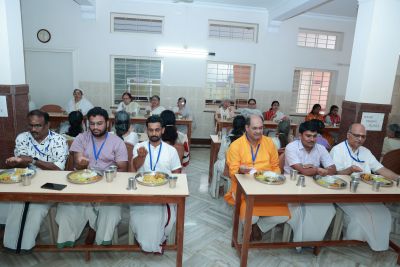 Participants joined volunteers as well as Ashram staff & workers in chanting ‘Brahmarpanam’ before meals in Annakshetra
The rest of the family on board
Mamatva in no way means doing away with one’s dharmic duty as a parent. It permeated Ma’s soft voice as she displayed a sense of responsibility and protectiveness over all devotees during the first morning when she addressed them saying “Welcome Home”. The grandness of her heart shone also in “Behind the Scenes in Ashram Life” sessions when she introduced the departments and staff of the Ashram. She remembered each person with his or her name, noting the duties and personal contributions of each to the Ashram, and in many cases recounting family histories going back several years. The participants came to know their newly discovered cousins so to speak who incessantly toil to maintain the buildings, the garden, the administration and support the personal needs of attendees while quietly being directed by the Brahmacharinis, themselves almost levitating about, in gentle demeanour, with a lightness imbued into their white sarees.
Torrential conclusions
No one would have guessed cyclone was around the corner. A larger family of animal companions was a nice distraction. Butterflies in the garden greeted me in the mornings; Surya Kumari seemed to like biting into my ochre skirt; Sumati, the mini-cat, decided to pay a visit and situate herself on my lap; and a gigantic spider landed above my desk in Room 21 signalling Brahman was playing its tricks on me too – though I had left the Mundaka Upanishad for another time and place. It scurried away as I tapped the wall.
The rains were lashing out on Kerala all of July and everyone was drenched – some physically, some mentally and some spiritually. I was thankful to have experienced all three levels of this monsoon in Guru-sannidhi.
EVENT SCHEDULE AND HIGHLIGHTS
| Date | Time | Program | Description |
|---|---|---|---|
| July 12, 2025 Saturday | 03.45 PM – 5.30 PM | Orientation & Introductions | Retreat – Orientation, participant introduction, observances |
| July 12, 2025 Saturday | 08.00 PM – 09.15 PM | Vivekachudamani Discourses & Q/A | |
| July 13, 2025 Sunday | 09.00 AM – 10.15 AM | * Discourse & Q/A based on ‘Vijnaana-nauka’ by Swami Nirviseshananda Tirtha | |
| July 13, 2025 Sunday | 10.30 AM – 11.30 AM | ||
| July 13, 2025 Sunday | 04.00 PM – 05.15 PM | * Discourses & Q/A by Poojya Swami Bhoomananda Tirtha ji | |
| July 13, 2025 Sunday | 08.00 PM – 09.15 PM | * Discourse & Q/A based on Vairaagya Shatakam and other scriptures by Swamini Ma Gurupriyaji | |
| July 14, 2025 Monday | 09.00 AM – 10.15 AM | * Discourse & Q/A based on ‘Vijnaana-nauka’ by Swami Nirviseshananda Tirtha | |
| July 14, 2025 Monday | 10.30 AM – 11.30 AM | ||
| July 14, 2025 Monday | 04.00 PM – 05.15 PM | *Discourses & Q/A by Poojya Swami Bhoomananda Tirtha ji | |
| July 14, 2025 Monday | 08.00 PM – 09.15 PM | *Discourse & Q/A based on Vairaagya Shatakam and other scriptures by Swamini Ma Gurupriyaji | |
| July 15, 2025 Tuesday | 09.00 AM – 10.15 AM | * Discourse & Q/A based on ‘Vijnaana-nauka’ by Swami Nirviseshananda Tirtha | |
| July 15, 2025 Tuesday | 10.30 AM – 11.30 AM | ||
| July 15, 2025 Tuesday | 04:00 PM – 05.15 PM | *Discourses & Q/A by Poojya Swami Bhoomananda Tirtha ji | |
| July 15, 2025 Tuesday | 08.00 PM – 09.15 PM | *Discourse & Q/A based on Vairaagya Shatakam and other scriptures by Swamini Ma Gurupriyaji | |
| July 16, 2025 Wednesday | 09.00 AM – 10.15 AM | * Discourse & Q/A based on ‘Vijnaana-nauka’ by Swami Nirviseshananda Tirtha | |
| July 16, 2025 Wednesday | 10.30 AM – 11.30 AM | ||
| July 16, 2025 Wednesday | 04.00 PM – 05.15 PM | *Discourses & Q/A by Poojya Swami Bhoomananda Tirtha ji | |
| July 16, 2025 Wednesday | 08.00 PM – 09.15 PM | *Discourse & Q/A based on Vairaagya Shatakam and other scriptures by Swamini Ma Gurupriyaji | |
| July 17, 2025 Thursday | 09.00 AM – 10.15 AM | * Discourse & Q/A based on ‘Vijnaana-nauka’ by Swami Nirviseshananda Tirtha | |
| July 17, 2025 Thursday | 10.30 AM – 11.30 AM | ||
| July 17, 2025 Thursday | 04.00 PM – 05.15 PM | *Discourses & Q/A by Poojya Swami Bhoomananda Tirtha ji | |
| July 17, 2025 Thursday | 08.00 PM – 09.15 PM | *Discourse & Q/A based on Vairaagya Shatakam and other scriptures by Swamini Ma Gurupriyaji | |
| July 18, 2025 Friday | 09.00 AM – 10.15 AM | * Discourse & Q/A based on ‘Vijnaana-nauka’ by Swami Nirviseshananda Tirtha | |
| July 18, 2025 Friday | 10.30 AM – 11.30 AM | ||
| July 18, 2025 Friday | 04.00 PM – 05.15 PM | *Discourses & Q/A by Poojya Swami Bhoomananda Tirtha ji | |
| July 18, 2025 Friday | 08.00 PM – 09.15 PM | ||
| July 19, 2025 Saturday | 09.00 AM – 10.15 AM | ||
| July 19, 2025 Saturday | 10.30 AM – 11.30 AM | ||
| July 19, 2025 Saturday | 02.00 PM - 03.00 PM | ||
| July 19, 2025 Saturday | 04.00 PM – 05.45 PM | ||
| July 19, 2025 Saturday | 08.00 PM – 09.15 PM |
Saturday
Retreat – Orientation, participant introduction, observances
Saturday
Vivekachudamani Discourses & Q/A
by Poojya Swami Bhoomananda Tirtha ji
Sunday
* Discourse & Q/A based on ‘Vijnaana-nauka’ by Swami Nirviseshananda Tirtha
Sunday
Sunday
* Discourses & Q/A by Poojya Swami Bhoomananda Tirtha ji
Sunday
* Discourse & Q/A based on Vairaagya Shatakam and other scriptures by Swamini Ma Gurupriyaji
Monday
* Discourse & Q/A based on ‘Vijnaana-nauka’ by Swami Nirviseshananda Tirtha
Monday
Monday
*Discourses & Q/A by Poojya Swami Bhoomananda Tirtha ji
Monday
*Discourse & Q/A based on Vairaagya Shatakam and other scriptures by Swamini Ma Gurupriyaji
Tuesday
* Discourse & Q/A based on ‘Vijnaana-nauka’ by Swami Nirviseshananda Tirtha
Tuesday
Tuesday
*Discourses & Q/A by Poojya Swami Bhoomananda Tirtha ji
Tuesday
*Discourse & Q/A based on Vairaagya Shatakam and other scriptures by Swamini Ma Gurupriyaji
Wednesday
* Discourse & Q/A based on ‘Vijnaana-nauka’ by Swami Nirviseshananda Tirtha
Wednesday
Wednesday
*Discourses & Q/A by Poojya Swami Bhoomananda Tirtha ji
Wednesday
*Discourse & Q/A based on Vairaagya Shatakam and other scriptures by Swamini Ma Gurupriyaji
Thursday
* Discourse & Q/A based on ‘Vijnaana-nauka’ by Swami Nirviseshananda Tirtha
Thursday
Thursday
*Discourses & Q/A by Poojya Swami Bhoomananda Tirtha ji
Thursday
*Discourse & Q/A based on Vairaagya Shatakam and other scriptures by Swamini Ma Gurupriyaji
Friday
* Discourse & Q/A based on ‘Vijnaana-nauka’ by Swami Nirviseshananda Tirtha
Friday
*Discourses & Q/A by Poojya Swami Bhoomananda Tirtha ji
Saturday