Discourse & Satsangs
Enlightened Living Residential Retreat (CIRD-Delhi) – 2025
START: SEPTEMBER 4, 2025
09:00 AM IST
END: SEPTEMBER 28, 2025
06:00 PM IST
VENUE:
CIRD - Delhi (NCR), Sector 5A, Vasundhara, Ghaziabad, Uttar Pradesh, India – 201 012
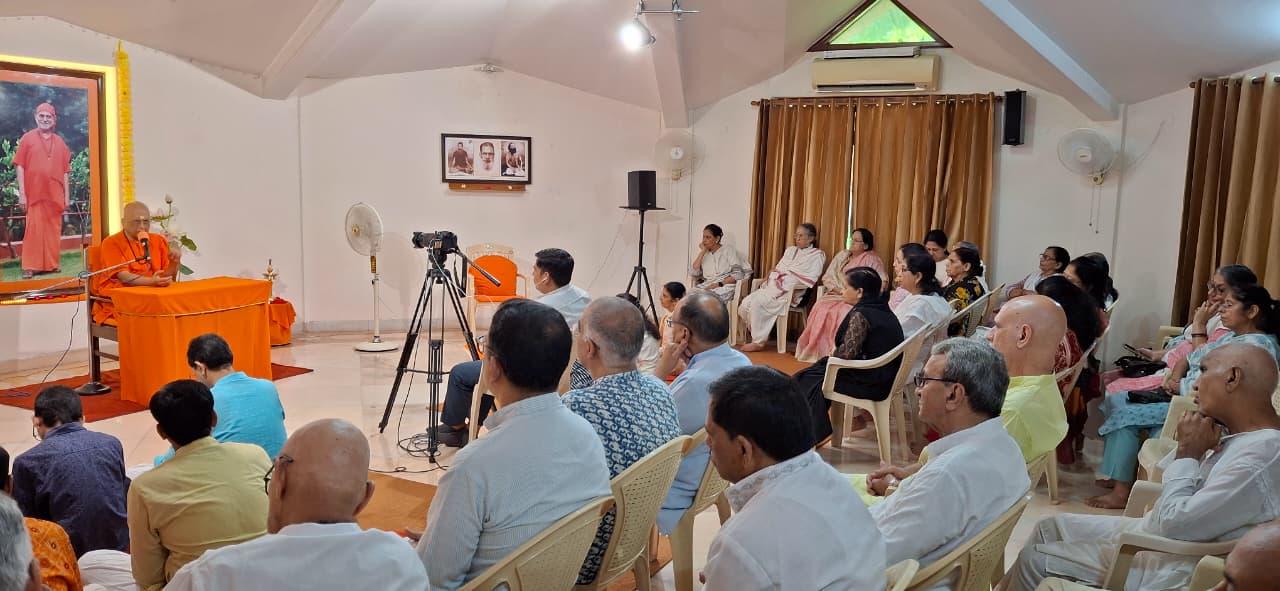
Photo: Enlightening Q&A sessions on weekend mornings (Sep 06 & 07, 27 & 28)
Swami Nirviseshananda Tirtha ji was in CIRD-Delhi, Vasundhara, Ghaziabad to conduct the Annual Sadhana Shibiram from 4th September to 28th September, 2025.
The main attraction during this year’s Sadhana Shibiram was the Enlightened Living Residential Retreat from 13 September to 21 September, 2025.
A Retreat Within
13th to 21st September, 2025
Shriya Bhat
[Shriya, aged 22 years, was the youngest participant at the Delhi Retreat this year. She has been associated with our Ashram through her mother, Dr Abha Bhat, who was herself a participant at the Jamshedpur Enlightened Living Retreat in 2016.]
It is often said that the mind reflects the environment it dwells in. Perhaps that is why I looked to the Ashram. Life outside had grown noisier and one could say I had almost run away from the world to seek asylum. I arrived with questions pressing in my heart: What is the truth of this world, and where is my place in it? Something deeper than reason had called me, so how could I refuse?
I had been to the Thrissur Ashram many times before, but it was my first time visiting the Delhi Ashram. It brought with it, however, the same refuge of peace that eases your mind and erases any thought of your troubles. Here was sanctity. Here was stillness. Here was the possibility of becoming more than the small, restless self.
Power of Prayer
The first day, at 6:10 in the morning the bell rang for Morning Prayers. By the time I joined the others in the Satsang Hall, voices were already rising together in ślokas. The sound carried was steady like the that of a river, with the soft morning light surrounding us in solidarity. The chants felt fresh with the day’s promise. What struck me most was not the chanting itself, but the silence that ensued. It was as if the sound had swept something away, leaving behind a space where the mind could rest.
By contrast, the Evening Prayers under fading light looked a different hue. They were a surrender; the day’s burdens laid to rest as day turns to dusk. I had always found the chanting of ślokas repetitive, saying sacred words with discipline. Nutan Swamiji had said in one of his lectures that chanting mechanically, like an exercise, will not make any difference in your sadhana. Only when the bhāva accompanies the words does the mantra truly become alive.
But during one of the evenings, when we chanted ‘Hare Rama Hare Krishna’ Mahā-mantra, I felt inner pulse within me. As the words flowed, tears welled up in my eyes from a sudden depth of connection.
We associate devotion with actions like pooja, prayers, idol worship, etc. But often our pursuit is not methodical. For that, we need to make our mind liberal and free of constrictions – which is the goal in itself. Bhakti, too, has to be enhanced by knowledge. If devotion is not there, then it becomes a powerless journey – like a mindlessly done exercise that does not benefit us.
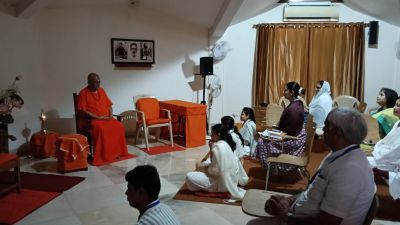 Nutan Swamiji with participants after Silent Sitting
Going Deep Within
Right after morning prayers, came Guided Meditation. I will admit, I was extremely sceptical of these sessions, when all my earlier attempts were in vain. Some mantras were played at the start of the session and the soothing music brought to my mind some focus. The example of a babool-tree standing firm along the riverbank came to my mind. I tried, unsuccessfully at times, but diligently, to embody that tree – rooted, steady, and unmoved.
Meditation was not very calming; it was confronting. In the quiet, thoughts rose that I had buried under the noise of daily life. Old fears, small envies, sudden flashes of anger, unhealed wounds – all came before me. At times, I felt restless, unable to just ‘be present’. It was in these moments, a need for introspection manifested.
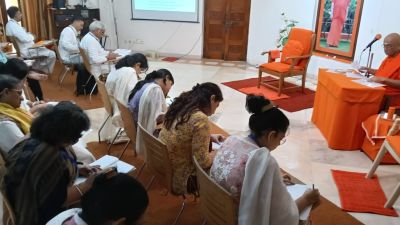 Guided Introspection - Participants writing their responses to probing introspection questions.
I poured some of these thoughts onto paper, during the Introspection and Writing Sessions. The act of writing did not just record them; it untangled them. I saw where I was chasing Preyas (the immediately pleasing), but also where Śreyas (the higher good) had led me. I saw how much of my sorrow came from clinging, and how much equanimity a situation can be handled with, when simply witnessed without judgment.
Introspection peels away the complex layers we cover the truth with, and takes us closer to our essence. It gave me a glimpse of Viveka-buddhi – the discriminating intelligence that sees clearly – and Vichara, the process of deep inquiry that keeps us honest with ourselves.
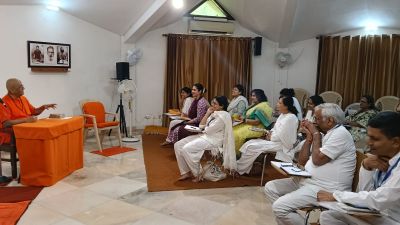 Morning classeson Sadhana-catu-ṣṭaya and Kathopanishad were exclusively for Retreat participants
Morning Classes – Sādhana-catuṣṭaya and Kathopanishad
I made my way every morning to the Satsang Hall, where I spent the better part of my days, listening to lectures and scribbling in my notebooks tirelessly. Even though many of the concepts discussed were those I had heard before – in earlier visits, in countless lectures – this time, they seemed to land differently. I could relate more deeply and accept them, not just as knowledge, but as something real and relevant to my own life. I almost felt sorry when the lecture ended; I could have gone on listening endlessly, letting each thought purify my mind, bit by bit.
The little voice in my head was given a name: Viveka. I learnt that only through Vichara – thoughtful inquiry into our actions – can we discover our mind’s constrictions and learn to discriminate between real and unreal, permanent and fleeting, pleasant and good. When Viveka strengthens, Vairagya dawns naturally. Desires begin to fade, the mind grows placid, and the true nature of life becomes clearer. To cure the disease of clinging to the fleeting, the medicine is Vichara.
The mornings were spent reading Kathopanishad and learning about Sādhana-catuṣṭaya. I hadn’t heard of Nachiketas’s story before, and since I have always loved mythology, it was the most engaging session for me. The stories of mythology gave practical lens to moral teachings. I felt almost like a child sitting in culture classes, but gaining so much wisdom. There is such a deep message hidden in every tale. On the surface, it seems simple, but when faced with our own moral dilemmas – the moments where we have to choose between Śreyas and Preyas – the decisions we make in those times are truly what define us as a person.
Nachiketas’s story pulled at a different knot in my mind. I had arrived with questions about truth, life and what lies beyond – and suddenly, I saw myself in Nachiketas, seeking answers in the same way. The truth was simple, yet not easy to embody. We are not confined to the body, mind or personality – we are the Consciousness that witnesses these all. It is wrong to think that through sadhana you will become the Self. We already are the Self – infinite, unchanging, ever-present. Just as the sun remains constant behind clouds, our Self remains untouched behind the veils of ignorance. When the clouds disperse, the sun doesn’t become brighter; we simply see it again.
Nutan Swamiji explained it beautifully: if a mirror reflects light, it is silly to think that the mirror is the source. When the mirror breaks, the light remains unchanged. Similarly, we are a manifestation of the inner Consciousness.
Nowadays, we take so much credit for whatever we do – every effort instantly stamped with our name. But when we spoke of the great works of ancient times, it struck me how much was once created without feeling any need for ownership. In those ages of spiritual abundance, when entire schools of thought were being shaped, so many saints never even signed their names. In one lecture, Nutan Swamiji narrated a short anecdote about Chaitanya Mahaprabhu, who once wrote a profound book on Nyaya. When he showed it to his friend – whose work was widely taught – his friend, realizing its brilliance, felt deep sorrow that his own text could never match it. Seeing his pain, Chaitanya Mahaprabhu promptly threw his own book into the river. There’s such deep wisdom in that act. On the surface, it seems easy to perform, but when faced with our own attachments – the urge to prove ourselves, the need for validation – such renunciation becomes almost impossible. These are the moments when Śreyas and Preyas truly collide, and our choices define us.
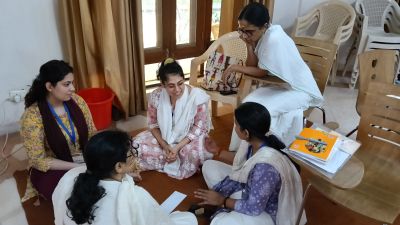 Afternoon activities: Group discussions based on morning Introspection and afternoon Reading Sessions
Enriching Afternoons
The Reading Sessions often brought stories that quietly unsettled me, the kind that make you hold a mirror up to your own emotions. I remember the tale of Sukanya, the cat who had lived in the Ashram long before. Listening to her story affected me a lot. My love for the animals around the Ashram – every dog, bird, and wandering soul – had always run deep, but I often confused compassion with attachment. How do you care without clinging? The answer, I was told, lay in Vairagya. Seeing them free from expectation, just as jeevan-muktas, who carry nothing within their minds. Their simplicity was a lesson on Vairagya: to love without holding, to witness without binding. It wasn’t just philosophy; it was practice.
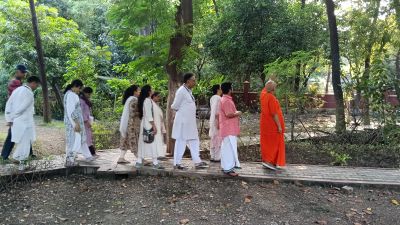 Nutan Swamiji enlightening participants on the foliage in CIRD-Delhi during evening Walking Satsangs
In the late afternoons, we gathered for Walking Satsang, flocking around Nutan Swamiji. The trees, the breeze, the rustling of leaves – all seemed to join the discussions. For me, the walk itself was a metaphor. The trees reminded me of standing tall in the face of adversity, the sky of vastness, the earth of grounding. Nature does not demand; it only shows what it is.
One day, on a walk, my friend and fellow Retreat participant, Vinita, and I saw a line of litter all along the road outside the Ashram gates. The sight of things strewn carelessly along the road brought to life the idea of a Cleaning Drive. The two afternoons spent tidying the Ashram (CIRD) and its surroundings became a quiet lesson in performing karma without attachment – doing the work for its own sake, without the pull of result or recognition. By the end, I felt lighter, as though my mind had been dusted clean alongside the courtyard.
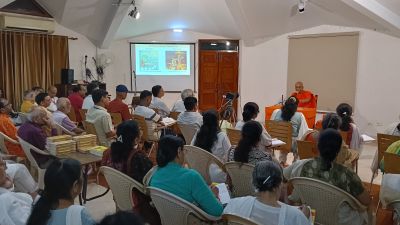 ‘Buddhi Yoga in Bhagavad Gita’ (Sep 13-20): Evening lectures during the Retreat were open to all seekers
New Light
In the evening lectures, we studied Buddhi-yoga of Bhagavad Gita. One teaching that stayed with me was: You can only fight. You may win, lose or fall – but you must fight with full sincerity, never being anxious about the outcome, which may be favourable, unfavourable or something in between. This touched something deep because I often struggle with disappointment when my efforts do not bear expected results. But to act with full sincerity and remain unaffected – that is true sadhana. Whatever makes the mind expand, universal and unaffected, is yoga.
It was said by Nutan Swamiji that without interactions, without reflecting in the company of others, I would never see the constrictions of my mind. Conversations revealed my attachments, my judgments, my blind spots. And yet, if I stepped back, I saw that it was not “me” clashing with “others”, but only two body-mind personalities interacting. The Self remains untouched, as a witness. So, the goals of interactional sadhana and meditation can be: “I am the unaffected knower of sukha and duḥkha.”
When we criticize someone for having a durguṇa (a bad quality or defect), it means we have the same durguṇa in ourselves. When I first heard this, it genuinely bothered me. It made me take accountability for my thoughts and actions, forcing me to see that judgment of others is often a mirror for self-correction. I began to approach people with softness instead of resistance, with understanding instead of opinion. Love, humility and warmth make the mind pervasive, allowing me to practise sadhana more effectively.
The teachings wove everything together. Whether it was chanting with bhāva, reflecting on Vairagya or eating meals with mindfulness, everything pointed to one truth: Transformation does not come from rote discipline, but from perceiving the truth that lies beneath the surface. The Ashram did not just give me answers in theoretical and bookish knowledge; it also gave experiences that asked me to keep looking inward.
Even meals in the Ashram were never just eating. The importance of eating sāttvika āhāra, simple and nourishing, was emphasized – not just in terms of food, but whatever inputs (āhāra) we are providing to mind.
We were asked at the end of the retreat if our perspective on spirituality had changed. I wouldn’t say it had changed, but I certainly found new ways of seeing it – new angles through which I now view life itself.
New spring to my old rhythmic step
Leaving the Ashram felt like I was stepping back into my old rhythm with new vigour and direction. My heart felt lighter, and there was a quiet hope towards a better way of being – a sense that change was not distant but already beginning. I felt bigger than the whole world and I wondered why I had ever let its noise sit on the same plane as this ocean of tranquillity.
Like Nutan Swamiji said – make your mind ‘pūrṇa’; don’t try to cover the whole world with leather, just wear shoes.
Jai Gurudev!
EVENT SCHEDULE AND HIGHLIGHTS
| Date | Time | Program | Description |
|---|---|---|---|
| Sep 6 & 7, 2025 Saturday-Sunday | 10:30 am - 12:00 pm | Q & A with Swamiji | |
| Sep 10, 2025 Wednesday | 8:00 pm - 9:15 pm | Satsangs | with Swami Nirviseshananda Tirtha |
| Sep 13 - 20, 2025 Saturday - Saturday | 8:00 pm - 9:15 pm | Buddhi Yoga Of Bhagavad Gita | Discourses by Swami Nirviseshananda Tirtha |
| Sep 13 - 21, 2025 Saturday - Sunday | __ | Walking the Inner Path Residential Retreat | with Swami Nirviseshananda Tirtha Register |
| Sep 24 & 26, 2025 Wednesday & Friday | 8:00 pm - 9:15 pm | Satsangs | with Swami Nirviseshananda Tirtha |
| Sep 27 & 28, 2025 Saturday-Sunday | 10:30 am - 12:00 pm | Q & A with Swamiji |
with Swami Nirviseshananda Tirtha
Discourses by Swami Nirviseshananda Tirtha
(Selected Applicants Only)
with Swami Nirviseshananda Tirtha
with Swami Nirviseshananda Tirtha